Historical evidence and complete configuration matrix#
How does contact shape grasping?#
Reproducible contact and friction experiments grounded in established physical laws and empirical relations. Findings come first; models, solvers, raw records and their limits follow.
What tasks can I run?#
Choose a task entry point, then use its documented protocol, environment and results. This table describes implementations with retained DexLab evidence. “Executed” includes failures; a pass applies only to the reported version, configuration and cases.
Task |
Implemented engines and validation |
Run and evidence entry points |
|---|---|---|
Inclined-plane friction and one-dimensional impact |
MuJoCo / SuperDex have paired incline cases, including failures; MuJoCo has recorded impact experiments |
|
Plane sliding, normal loading / unloading, and cylinder pinch |
MuJoCo / SuperDex / PhysX development cases executed, retaining failures and geometry refinement |
|
Finite-fixture pinch, lift, hold and release |
Genesis completed 16 force-limit cases for studying drive limits and failure mechanisms |
|
Robot SDF apple-stem grasp |
MuJoCo / SuperDex passed the specified 14 s scene; PhysX has separate single-scene acceptance with its own configuration and preparation chain |
|
Cloth extension, sag, sphere draping and pre-folded drop |
MuJoCo flex / SuperDex shell / Newton Physics have historical experiments, including failures; PhysX surface cloth has separate passive cases, without per-node-force extension support |
|
Robot cloth grasp, lift and release |
One specified 9 s MuJoCo 3.14 development case passed the limited protocol; self-contact is near the threshold and robustness remains unproven |
|
Basic rigid sphere–plane contact |
Newton Physics 1.6.1 / XPBD normal, repeat and collision-disabled controls passed admission; robot grasping is outside this test |
Two-hand cloth folding has no demonstrated success. Matched MuJoCo/MJWarp3.11.0 now runs natively beside Isaac Sim. The native support case also fails the frozen momentum check; aligning four GPU fields preserves that failure and still differs from the framework. Three independent aligned runs match exactly. CPU contact readback now rejects out-of-bounds addresses. Reliable task coverage is unchanged. Results and attribution limits.
Drake 1.57.0 passes six of nine initial incline cases; all three sliding cases fail and the negative is correctly rejected. Full records. #143 verifies adapter correspondence; the full research campaign remains #130.
Coverage describes research scope; selection also depends on physical credibility, stability and cost for the target scene. We assess task types alongside physical credibility, stability across conditions and execution cost. Reliably completing more task types under retained criteria expands a configuration’s validated scope. Installation, adapter declarations, multiple solvers for one task and repeated runs do not add task types; pass counts from different historical protocols do not form a universal ranking.
Task coverage by solver#
MuJoCo 3.15.0 initial six-profile qualification: elliptic 3/9 each, pyramidal 0/9 each; all six negatives rejected. CG/Newton pyramidal each retain three invalid force/state records. 详细证据 / Evidence.
Across twelve SuperDex 1.0.0 FP64 incline profiles, nine pass 8/9 and three CG paths pass 6/9; all negatives are rejected, and five CUDA options are unsupported in the official build. Failures and historical gaps remain explicit. Evidence / 详细证据.
BFGS/SR1 retain an assembly period of one and therefore execute Newton-equivalent steps; these are configuration rows, not two extra qualified algorithms.
Five native Genesis 1.4.3 incline profiles pass 6/9, 3/9, 0/9, 0/9 and 0/9. Native contacts floor nominal-zero friction to .01; all seven invalid CG records remain, with source-linked stopping diagnostics. Evidence / 详细证据.
Seven native Newton Physics 1.6.1 incline profiles pass 1/9, 0/9, 0/9, 0/9, 0/9, 1/9 and 4/9. Numerical checks reject 49 positives and both VBD negatives. DVI timeout and explicit continuation remain visible; no engine ranking or reliable coverage is claimed. Evidence.
Four native PhysX SDK 5.9.0 incline profiles pass 7/9, 7/9, 3/9 and 3/9. All four negatives are valid and rejected; 13 positives fail frozen numerical checks. All failures and raw observations remain. No reliable coverage or framework-path performance is inferred. Results and reproduction · Precision validation #163.
Drake 1.57.0 now has six incline configurations across three SAP approximations and point/hydroelastic contact: the reused cohort passes6/9, and new profiles pass0/9,5/9,0/9,3/9,2/9. Five new positives exceed the original momentum check; all failures remain. Source equations reconstruct old Lagged sliding forces within4e-13 N. Reliable task coverage is unchanged. Protocol, results and reproduction · Residual follow-up #165.
States: passed / partial / failed / not run / blocked / unsupported. Cells link to evidence or recovery conditions.
Historical protocols remain separate; a pass applies only to its protocol. Reliable coverage under the new protocol requires positive and negative cases, independent physics scoring, frozen holdouts and equal tuning budgets.
Rigid tasks · historical protocols#
Core / solver / path / version / cohort |
Basic contact |
Incline |
Collision |
Fixture pinch |
Robot grasp |
|---|---|---|---|---|---|
MuJoCo · Newton / Euler |
|||||
MuJoCo · PGS / elliptic / Euler |
|||||
MuJoCo · PGS / pyramidal / Euler |
|||||
MuJoCo · CG / elliptic / Euler |
|||||
MuJoCo · CG / pyramidal / Euler |
|||||
MuJoCo · Newton / elliptic / Euler |
|||||
MuJoCo · Newton / pyramidal / Euler |
|||||
SuperDex · Newton / AUTO / FP64 |
|||||
Genesis · Newton / approximate_implicitfast |
|||||
Genesis · Newton / approximate_implicitfast |
|||||
Newton Physics · XPBD |
|||||
PhysX · historical readback incomplete (#126) |
|||||
Drake · SAP / kLagged / hydroelastic |
|||||
MuJoCo · Newton / implicitfast |
|||||
SuperDex · Newton / GMRES / FP64 |
|||||
SuperDex · NEWTON / AUTO / C1_REGULARIZED |
|||||
SuperDex · NEWTON / CG / C1_REGULARIZED |
|||||
SuperDex · NEWTON / GMRES / C1_REGULARIZED |
|||||
SuperDex · NEWTON / AUGMENTED_CG / C1_REGULARIZED |
|||||
SuperDex · NEWTON / LDLT / C1_REGULARIZED |
|||||
SuperDex · NEWTON / LU / C1_REGULARIZED |
|||||
SuperDex · NEWTON / ASYNC_CG / C1_REGULARIZED |
|||||
SuperDex · NEWTON / PARALLEL_CG / C1_REGULARIZED |
|||||
SuperDex · NEWTON / MINRES / C1_REGULARIZED |
|||||
SuperDex · BFGS / AUTO / C1_REGULARIZED |
|||||
SuperDex · SR1 / AUTO / C1_REGULARIZED |
|||||
SuperDex · NEWTON / AUTO / CINF_REGULARIZED |
|||||
SuperDex · NEWTON / CUDA_CG / C1_REGULARIZED |
|||||
SuperDex · NEWTON / CUDA_GMRES / C1_REGULARIZED |
|||||
SuperDex · NEWTON / EXPERIMENTAL_CUDA_SPARSE_CHOLESKY / C1_REGULARIZED |
|||||
SuperDex · NEWTON / EXPERIMENTAL_CUDA_SPARSE_LDLT / C1_REGULARIZED |
|||||
SuperDex · NEWTON / EXPERIMENTAL_CUDA_SPARSE_LU / C1_REGULARIZED |
|||||
Genesis · Newton / elliptic / signorini / approximate_implicitfast |
|||||
Genesis · Newton / elliptic / convex / approximate_implicitfast |
|||||
Genesis · Newton / pyramidal / convex / approximate_implicitfast |
|||||
Genesis · CG / elliptic / convex / approximate_implicitfast |
|||||
Genesis · CG / pyramidal / convex / approximate_implicitfast |
|||||
Genesis · Newton / pyramidal / Signorini |
|||||
Genesis · CG / elliptic / Signorini |
|||||
Genesis · CG / pyramidal / Signorini |
|||||
Newton Physics · XPBD / 100 sweeps |
|||||
Newton Physics · SemiImplicit |
|||||
Newton Physics · Featherstone |
|||||
Newton Physics · VBD legacy / 100 sweeps |
|||||
Newton Physics · VBD compliant / 100 sweeps |
|||||
Newton Physics · Kamino / PADMM / Euler |
|||||
Newton Physics · Kamino / DVI / Euler |
|||||
Newton Physics · Style3D |
|||||
Newton Physics · ImplicitMPM |
|||||
MuJoCo · SolverMuJoCo; algorithm unqualified |
|||||
PhysX · PGS / patch friction |
|||||
PhysX · PGS / friction every iteration |
|||||
PhysX · TGS / patch friction |
|||||
PhysX · TGS / external forces every iteration |
|||||
Drake · SAP / kLagged / point |
|||||
Drake · SAP / kSimilar / hydroelastic |
|||||
Drake · SAP / kSimilar / point |
|||||
Drake · SAP / kSap / hydroelastic |
|||||
Drake · SAP / kSap / point |
|||||
MuJoCo · MJWarp Newton / pyramidal / Newton contacts |
|||||
MuJoCo · MJWarp Newton / pyramidal / MJWarp contacts |
|||||
MuJoCo · MJWarp Newton / pyramidal / MJWarp contacts |
Manipulation · historical protocols and gaps#
Core / solver / path / version / cohort |
Pushing |
In-hand rotation |
Cloth grasp/lift |
Active folding |
|---|---|---|---|---|
MuJoCo · Newton / Euler |
||||
SuperDex · Newton / AUTO / FP64 |
||||
Genesis · Newton / approximate_implicitfast |
||||
Newton Physics · XPBD |
||||
PhysX · pending qualification |
||||
Drake · SAP / kLagged / hydroelastic |
||||
MuJoCo · Newton / implicitfast |
||||
Genesis · PBD / rigid coupling |
Cloth tasks · separate historical protocols#
Core / solver / path / version / cohort |
Extension |
Sag |
Sphere drape |
Folded drop |
|---|---|---|---|---|
MuJoCo · Newton |
||||
SuperDex · experimental-shell |
||||
Newton Physics · xpbd |
||||
Newton Physics · vbd |
||||
Newton Physics · semi_implicit |
||||
Newton Physics · featherstone |
||||
Newton Physics · style3d |
||||
Genesis · PBD / rigid coupling |
||||
Drake · not qualified |
||||
PhysX · surface cloth |
Reliable coverage under the new protocol: not yet qualified. Existing capabilities remain valid within their original protocols; historical runs are not retroactively admitted.
Cloth counts are recomputed from 105 historical summaries, not rescored trajectories. Featherstone cloth uses semi-implicit particle kernels; folded drop is not active folding. Missing runs do not establish lack of support.
Inventory and generation rules
Genesis 1.4.3 PBD actuated cloth clamping/holding was run and failed; see the retained negative results. Its plane support, stretch/bend response and connected-fold diagnostics are different from the seven-profile shared cloth holdout protocol.
The coverage-first development plan proceeds through migration discrepancies, independent engine baselines, native MJWarp/Isaac Sim comparisons, then pushing, rotation and cloth. The 594-case pinch study advances between newly delivered task types. Native paths use latest stable cores; frameworks use official compatible combinations, with matched-core attribution studied separately.
Three findings to start with#
Engine names do not predict the outcome. SuperDex satisfies more checks in the fixed incline comparison; a historical higher-impedance MuJoCo profile has less static drift.
24/27 endpoint passes; 2/27 also meet the overlap budget. Collision velocity, energy and overlap must be checked separately.
The cube still slips about 2 mm after tightening tolerances. Numerical consistency and grasp retention are different outcomes.
One cube. Two fixed profiles.#
40 mm · 64 g · matched initial state and gravity · 2 / 1 / 0.5 ms timesteps · 2 seconds per case. Verified MuJoCo records are reused; nine SuperDex cases are new. An interim paired comparison, not a six-engine ranking.
Case and observation |
MuJoCo 3.15.0 |
SuperDex 1.0.0 FP64 |
|---|---|---|
15° static friction, μ=0.5 · displacement |
1.301–1.336 mm · 0/3 pass |
0.708–1.132 mm · 2/3 pass |
35° sliding, μ=0.5 · support and motion |
Rotation, intermittent support loss · 0/3 |
Stable sliding in scoring window · 3/3 |
15° nominal zero friction · velocity RMSE |
8.21×10⁻⁵ m/s · 3/3 |
8.04×10⁻¹²–1.52×10⁻¹⁰ m/s · 3/3 |
Solver settings. MuJoCo: Newton / Euler / elliptic, impedance=0.9, 100 iterations maximum, tolerance 1e-10. SuperDex same-byte reconstruction: Newton / AUTO (dense LDLᵀ on the small-system source path) / C1-regularized friction; historical readback: Backward Euler, 100 iterations, absolute/relative tolerance 1e-9. Identity, combination law and historical telemetry gap #124. Equal μ is not material or contact-model equivalence. Velocity errors use the 0.5–2 s window; the report preserves initial transients and failures.
Full results and raw data · Frozen protocol · Parameter manifest
Six engines. What is covered?#
This index links cohorts sharing the initial physical conditions. Native observations and scoring are frozen separately; this is not a shared-tuning/holdout six-engine ranking. Historical identities remain separate from new admissions. The generated matrix above lists every solver configuration.
Engine |
Recorded version / solver |
Nine paired incline cases |
Other evidence |
|---|---|---|---|
MuJoCo |
3.15.0 / Newton |
Executed, including failures |
Collision and pinch diagnostics |
SuperDex |
1.0.0 FP64 / Newton reconstruction; historical telemetry limit |
Executed, including failures |
Loading, parameter transfer |
Genesis |
1.4.3 / five native configurations |
Historical force-limit evidence separate |
|
Newton Physics |
1.6.1 / Warp 1.18.0 / seven native configurations |
Executed, including failures, interruption and explicit continuation |
Separate sphere–plane negatives |
PhysX |
Native SDK 5.9.0 / four PGS/TGS profiles |
Historical framework core gaps remain; comparison #152 |
|
Drake |
1.57.0 / SAP / kLagged / hydroelastic |
Negative correctly rejected; other profiles #151 |
Historical audits #124, #125 and #126 complete bounded searches and attribution review: SuperDex same-byte reconstruction, Genesis matching-source derivation and three PhysX scene readbacks remain distinct. Missing telemetry stays missing; unsupported exact-core and algorithm-causality attribution is withdrawn. Engine qualification children carry new experiments with separate records; closing these audits adds no reliable task coverage.
Follow-up work and blockers · PhysX integration #47. Frameworks and native engines are distinct; Newton Physics is not MuJoCo’s Newton algorithm.
Next: unified-drive pinch boundary#
A 24-process native diagnostic isolated batched parameter storage as the low-force discrepancy factor. The subsequent storage-aligned comparison passed all 19 pairs and 12 exact reset replays across 38 launches / 56 episodes, at unchanged thresholds. The six earlier failed pairs and low-force grasp failures remain recorded. This result covers the disclosed Genesis 1.4.3 / local adapter patch combination and adds no task type. Cause, evidence and reproduction · #143.
Development roadmap · Discussion · Research tracker
Common protocol and data contract v1 now defines the finite fixture, 1 ms external-PD clock, 594 formal cases, 24 controls and up to 32 qualification/bridge cases, with case expansion and record-shape checks. Backend qualification and independent scoring are next; no backend is admitted and no formal campaign has run. Six-engine gaps and historical evidence scope remain explicit.
How we check#
Define the reference first. Static friction |f| ≤ μₛN, threshold tanθ=μₛ, sliding acceleration a=g(sinθ−μₖcosθ). Declare rigid-body/Coulomb assumptions, initial conditions and applicability before comparison.
Freeze cases and expose differences. Match mass, inertia, geometry, frames, controls and initial state; record engine/solver versions, precision, timestep, budgets and contact parameters.
Retain failures and test sensitivity. Report absolute errors, trajectories, convergence/sensitivity and cost. Support loss, rotation and unobservable parameters do not disappear into averages.
Keep evidence levels separate. Analytical verification, sourced empirical references and real-system validation are different. The first two can proceed independently but do not replace measured calibration of a specific material.
From contact experiments to grasping#
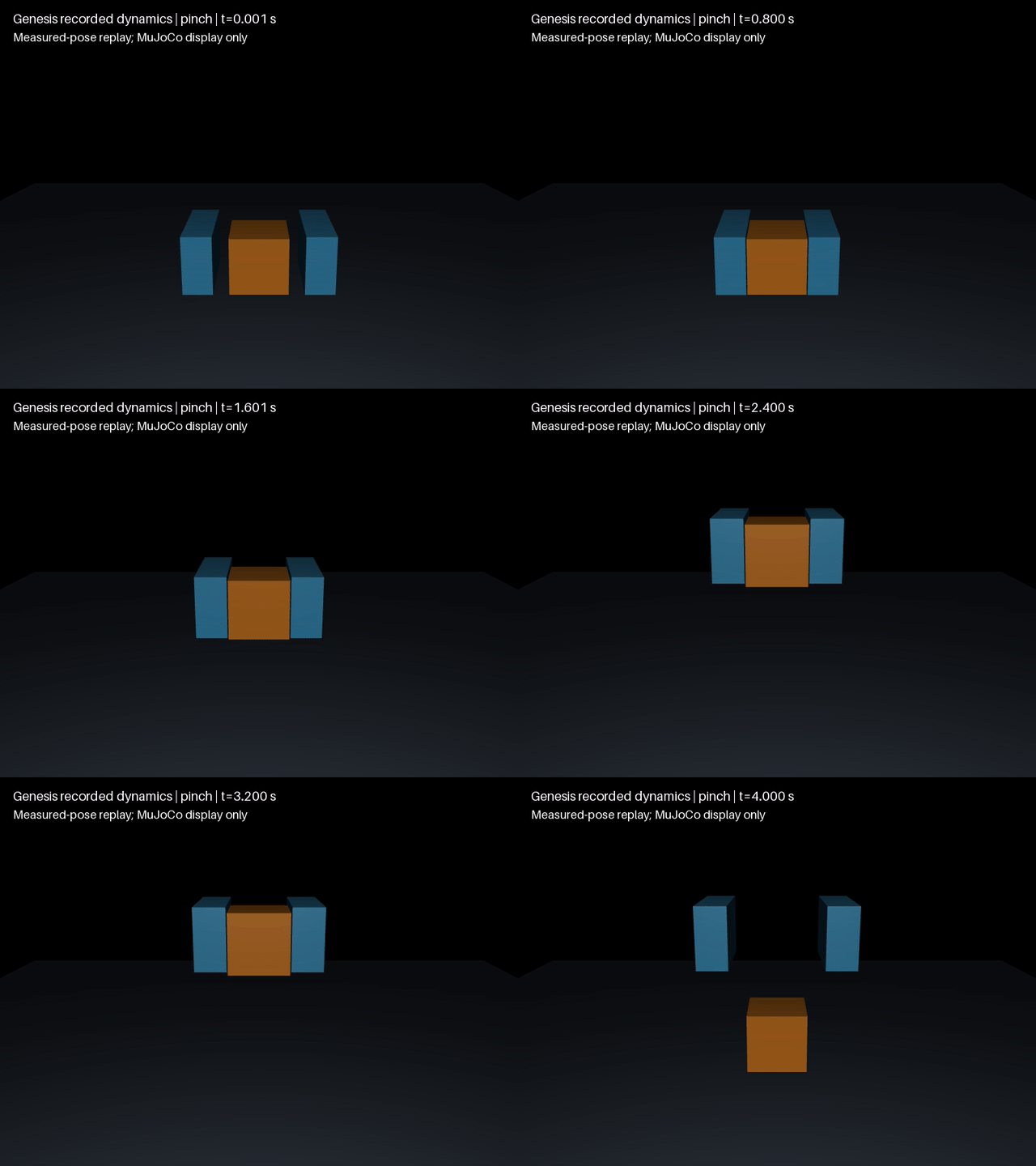
Continuous replay of native Genesis states, displayed by MuJoCo. In16 fixed cases, 0.2/0.4 N force caps cannot retain the object; 0.8/10 N hold and release, including ±2 mm initial offsets. This is a fixture-specific result, not a cross-engine grasp ranking.
Force-limit report · All research results · Installation and reproduction
Learn the engines: Sim Atlas#
The Sim Atlas learning home organizes application and physics/source tracks for six engines, shared foundations and their course repositories. The project tracker records actual development progress. Courses currently focus on engine mechanisms; later cases reuse DexLab versions, workloads and evidence. Course completion and experimental coverage are tracked separately.