Results and failures#
The solver failure audit separates missing coupling, failed configurations and execution errors across RSS and existing DexLab evidence.
Paired engine incline comparison#
Same cube, three timesteps, complete paired report: fixed profiles yield MuJoCo 3/9 and SuperDex 8/9 passes. Drift, initial transients and the lower drift of higher-impedance MuJoCo remain visible; no universal ranking.
The 16-case block force-limit experiment is complete: 0.2/0.4 N fail retention, 0.8/10 N hold and release, including ±2 mm offsets. Numerical validity and task outcome are separate; no hardware-fidelity claim.
Genesis PBD cloth: failures remain visible#
The tested official PBD/rigid frictional grasp profile is rejected: same-step momentum residual 3.2e-5 kg·m/s exceeds the 3.3e-7 bound; actual gripper lift reaches 79.988 mm while cloth stays at 4 mm, including both preregistered offsets. The 36-cell equal-time response shows strong timestep sensitivity. Connected-fold saved-state checks pass but establish neither continuous collision nor material accuracy. Full protocols, all results and raw records.
Newton XPBD: bounded positive and negative contact evidence#
The CPU sphere–plane profile passes its preregistered engineering bounds; maximum intrusion is 0.000849 mm and hold-force error is 0.051353%. A rebuild repeat is identical; a collision-disabled negative loses support and matches discrete free fall. These are synthetic primitive checks, not grasp, SDF or hardware qualification. Complete traces, thresholds, raw data and limitations.
What standard judges an experiment?#
Lifting an object is a task outcome, not a reference answer for physical accuracy. Report three separate levels.
Level |
Independent reference and check |
Supported claim |
|---|---|---|
Implementation consistency |
Analytical references under stated assumptions, force/momentum balances, no-contact/zero-friction/release negatives |
Detect implementation and recording errors; does not establish real-material accuracy |
Numerical reliability |
Hold the physical model fixed; refine timestep and solver accuracy while recording errors, residuals and cost |
Characterize numerical sensitivity over tested settings; self-convergence does not validate the physical model |
Physical validity |
Same-apparatus force-displacement, slip threshold and release measurements with uncertainty |
Measure error relative to reality; currently unknown without hardware data |
Before each new experiment, freeze the hypothesis, reference and its assumptions, controlled and varied quantities, metrics and units, rejection criterion and rationale, budget and retention of all failures. Without a justified accuracy tolerance, report error/response curves rather than inventing an accuracy pass after observing results. Existing engineering thresholds define task acceptance; latest-stable admission is not physical validation.
Apple-stem grasp is a downstream integrated task. The historical ten scenes describe specific configurations on a specific perturbation set; their difference cannot be attributed to the engine. Parameter readback establishes what was used, not whether the contact law is physically accurate. The next contact study should hold physical assumptions fixed and examine timestep/solver refinement before error-cost interpretation; hardware calibration requires measurements tracked in #6.
Current development evidence#
The newest records answer narrower questions than the historical robustness cohorts below. They use official MuJoCo 3.14.0 and SuperDex 1.0.0 FP64 where applicable; a release regression pass does not requalify an older benchmark.
Question |
Observed result |
Interpretation |
|---|---|---|
Can the repaired cloth case complete pinch, lift and release? |
One 9 s development case passes; maximum strain 3.5161%, self penetration 1.492 mm against a 1.5 mm limit |
A working candidate with only 7.95 µm penetration margin; robustness remains untested |
Do equal nominal friction coefficients give equal low-speed response? |
All 16 development runs meet their fixed physical criteria; forward 1–10 mm/s median resisting ratios: MuJoCo 0.15641, SuperDex 0.02076 |
Different effective response, not an engine-accuracy ranking or measured material fit |
Has physical hardware accuracy been established? |
No measured calibration dataset |
The acquisition protocol is ready; hardware validation is not complete |
Cloth metrics, continuous close-up, parameters and failed controls · Friction curves, all 16 cases, frozen configuration and raw archive · Hardware protocol
The cloth maxima scan all 72,000 physics steps; force observations are 100 Hz and geometry checks cover 225 saved frames at 25 Hz. Zero sampled table/robot/floor crossings does not prove continuous finite-thickness separation. The friction ratio uses center-of-mass velocity and net contact force, excluding near-rest and direction-reversal intervals: it is not material-point slip. Bin medians do not match individual speeds across engines. Different settled heights are retained in the report.
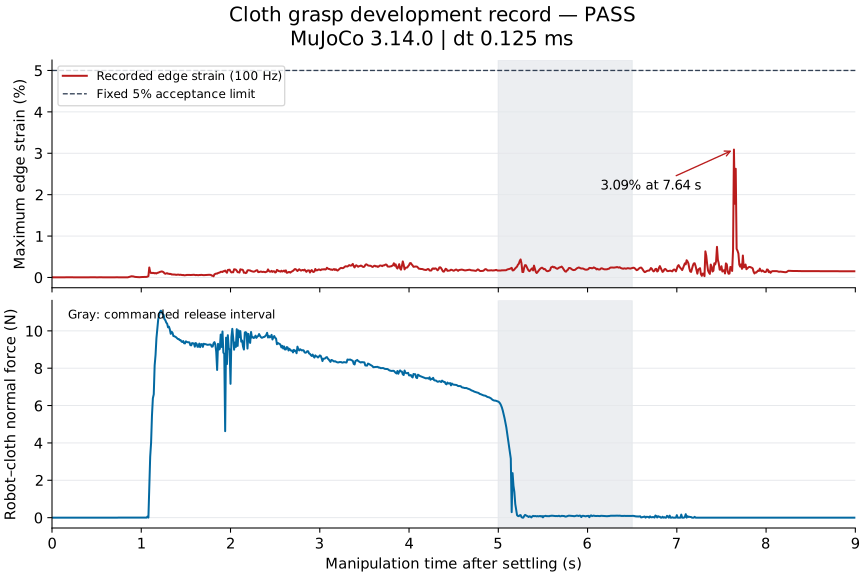
Cloth plots sample at 100 Hz; the acceptance extrema use every physics step. The plotted strain peak is 3.0891%, not the 3.5161% per-step maximum.
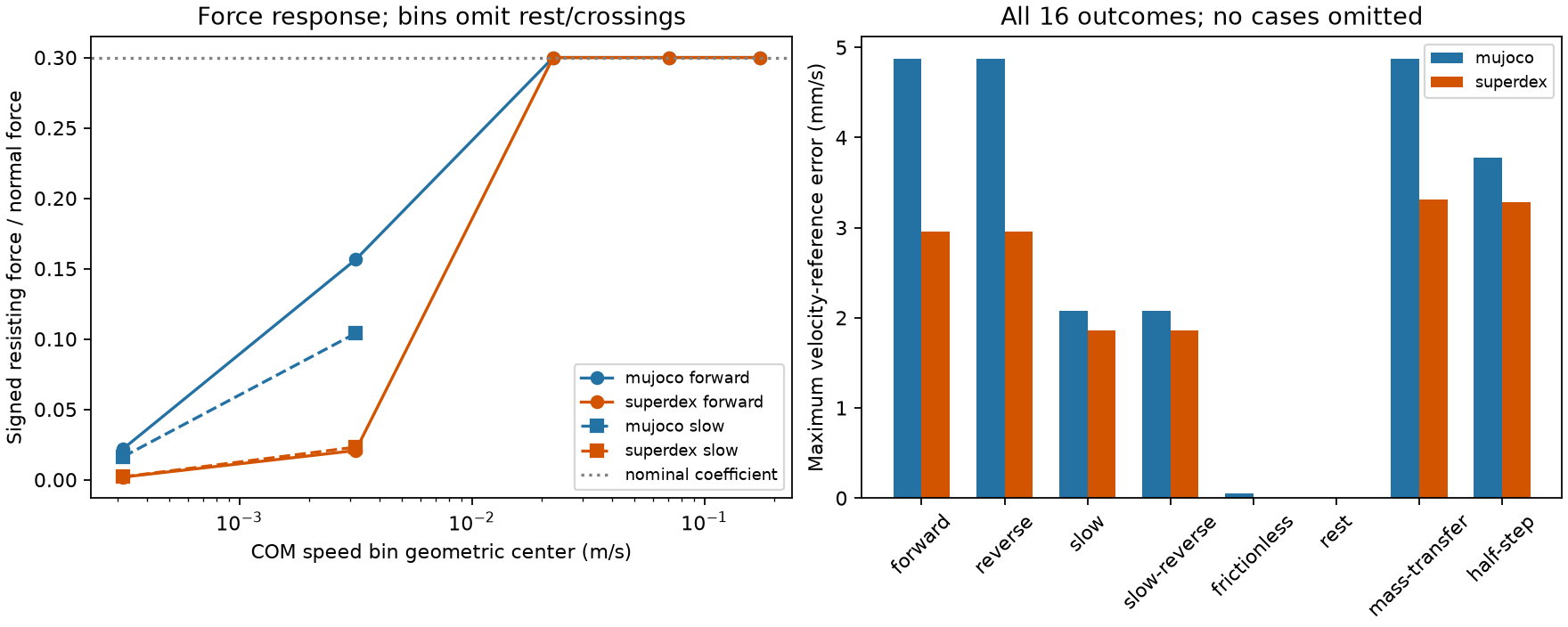
The friction figure includes all 16 development outcomes; empty speed bins are missing coverage, not zero resistance. The linked reports contain exact source/configuration hashes and failed development controls.
Contact onset: timestep and stopping-tolerance sensitivity#
Sixteen timestep episodes fix observed starts, contact parameters and native solver profiles. Twelve additional SuperDex episodes independently tighten stopping tolerances. All failures remain. These values are response differences, not errors against reality.
Control |
Result |
Supported interpretation |
|---|---|---|
Timesteps1→0.5→0.25→0.125ms |
Frictional maximum position differences: MuJoCo0.06117→0.03538→0.01539mm; SuperDex1.47480→1.96621→1.24122mm |
Decreasing differences for the former in this range; the latter does not establish convergence |
SuperDex tolerances tightened100/10,000× |
Position differences between0.5 and0.125ms remain about3.206mm frictional and0.5545mm frictionless |
Stopping-tolerance tightening alone does not remove timestep sensitivity; the mechanism is not fully identified |
Engineering acceptance |
Timestep batch12/16; tolerance batch6/12 |
All10 failures retained; passing frictionless cases do not establish numerical or hardware accuracy |
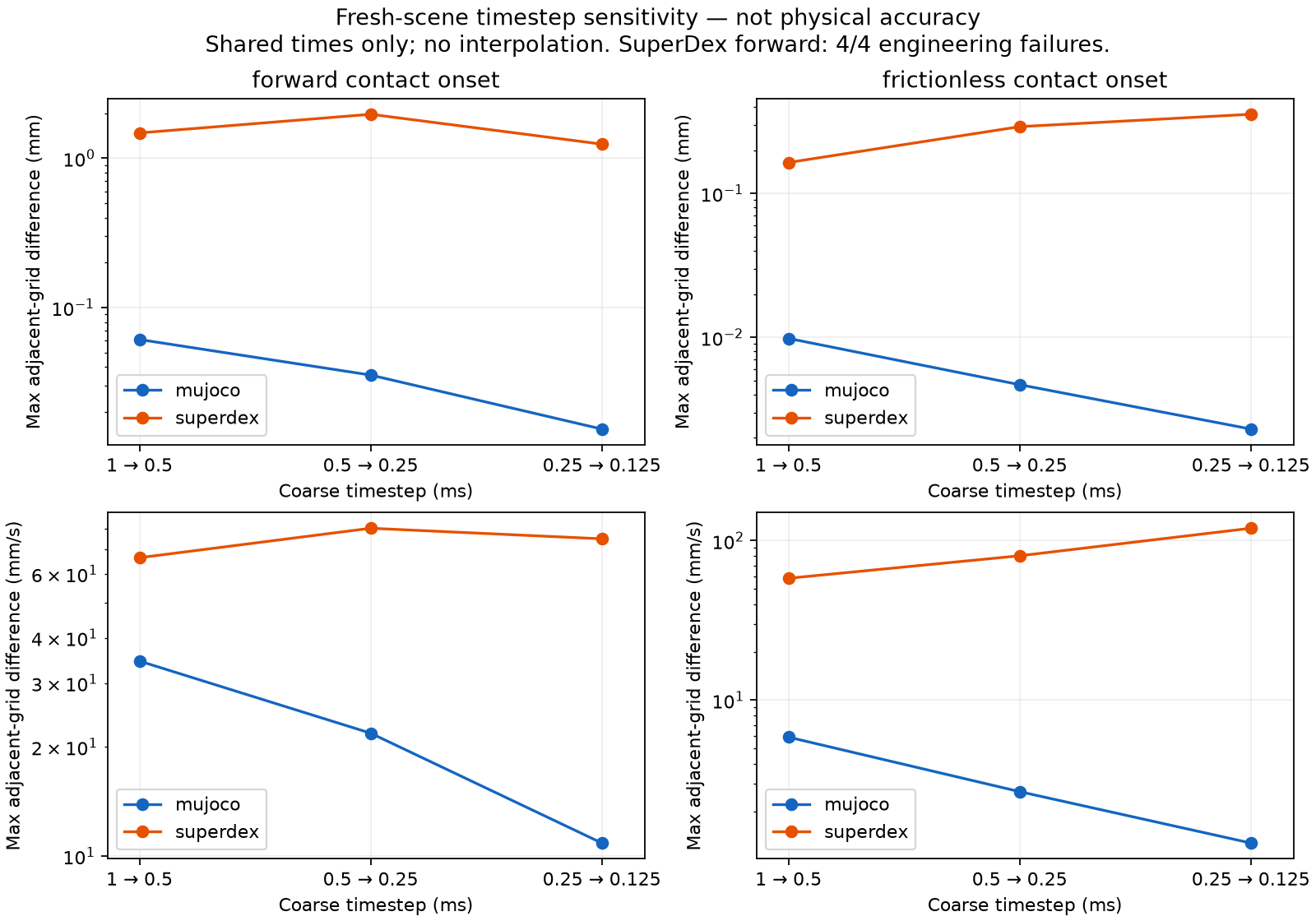
Protocol, assumptions, all per-run parameters and costs. The finest grid is not truth; no convergence order is fitted. All28 scores match offline rescoring with their original frozen sources. Raw-archive publication awaits this release.
Cost and reproducibility#
Cloth simulation-loop wall time was 618.86 s and service wall time 642.18 s, including preparation and recording. The friction report separates preparation and stepping-plus-observation time. Neither isolates native stepping, renderer, evaluator and transport costs under a shared speed benchmark; unmeasured components remain unknown. Replaying saved states or rescoring an archive does not rerun dynamics. Follow each linked report’s exact configuration and version rather than replacing the historical runtime silently.
How to read a pass#
Task completion, physical validity and temporal coverage are distinct. An object reaching its target or a robot becoming still is not proof of sustained frictional support or nonpenetration. Following the ManiSkill source review, report all three, and keep unsupported or incomplete checks visible.
The friction fixture has no learned controller: one prescribed initial velocity follows native settling, then the body evolves freely. Its eight declared cases vary direction, initial speed, mass, friction and timestep; these are development controls, not held-out object splits. All 16 outcomes are included. The apple cohort below freezes ten perturbations of the same apple asset, not ten unseen object geometries. The cloth candidate uses known-state IK and an explicit pinch prior; its failed development controls remain in the linked report. Actual initial states, native versions, solver settings, precision and source hashes are recorded with each raw record. The version inventory records when releases were checked; it is not a guarantee that those versions remain latest forever.
Historical evidence#
The following records retain their original versions and protocols. They do not rank physical accuracy.
Apple grasp: fixed-configuration robustness#
Ten frozen scenes vary mass, horizontal position and orientation: twenty runs across two backends, without retuning for these cases.
Historical configuration |
Complete acceptance |
95% Wilson interval |
|---|---|---|
MuJoCo 3.11.0, 0.5 ms |
1 / 10 |
1.8–40.4% |
SuperDex 1.0.0 FP64, 2 ms |
10 / 10 |
72.2–100% |
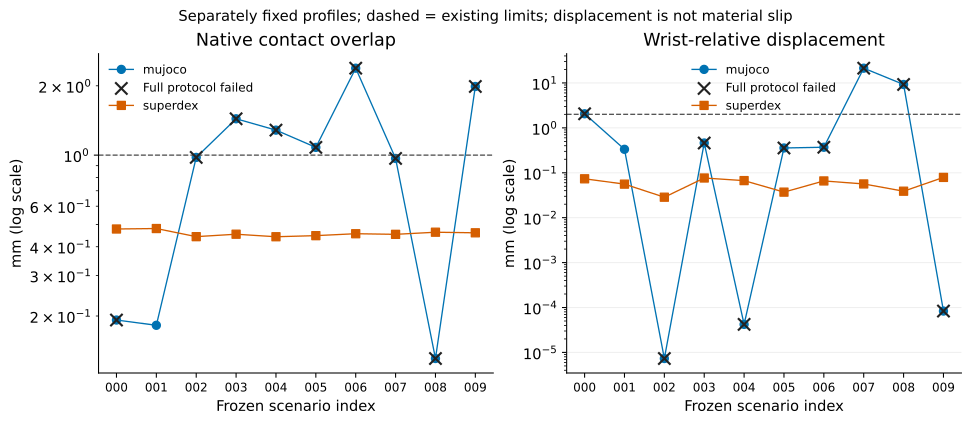
Crosses denote full-protocol failure. Native contact overlap is not independent surface penetration; wrist-relative displacement is not material-point slip. Timesteps, friction and drives differ, without matched calibration or tuning budgets. PhysX’s default development case is separate from these twenty runs.
Cloth: retain and explain failure#
The original nine-second trajectory has cloth-triangle/table intersection in 176 of 225 saved frames, with maximum interior depth 3.00 mm. Correcting the missed detection does not repair the trajectory. The diagnostic checks zero-thickness triangles, not continuous finite-thickness separation.
Historical cohorts#
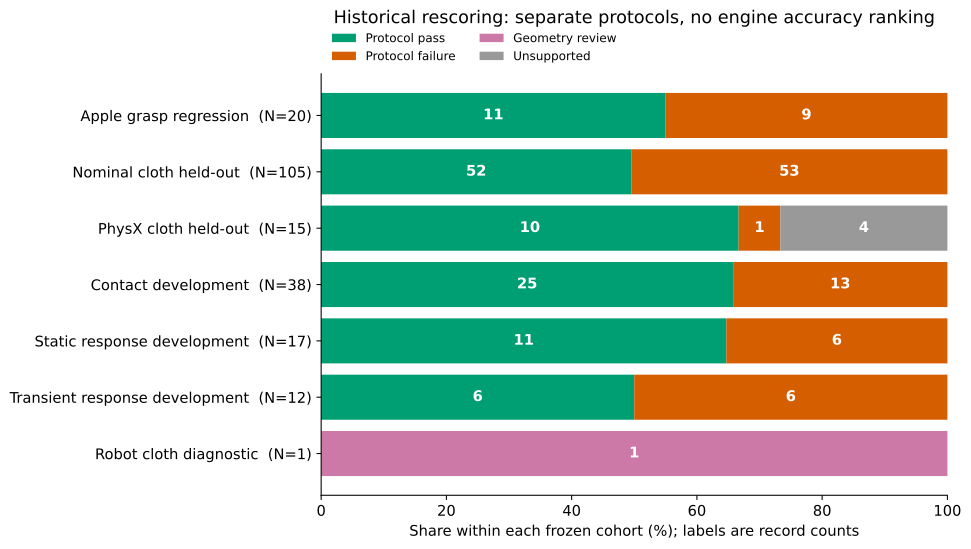
Each row has a different task and protocol. Retain failure, geometry review and unsupported outcomes; do not pool denominators into a global success rate or relabel development data as independent tests.
Missing evidence#
No formal hardware calibration set or independent measured accuracy.
Historical timings do not share an isolated protocol; no speed ranking.
Persistent material-point correspondences are unavailable; slip is unknown, not zero.
MuJoCo 3.14.0 has the explicitly scoped development and regression evidence above. Genesis task qualification remains pending; none of these results establishes all-engine or all-task qualification.
Synthetic response discrepancy and cost#
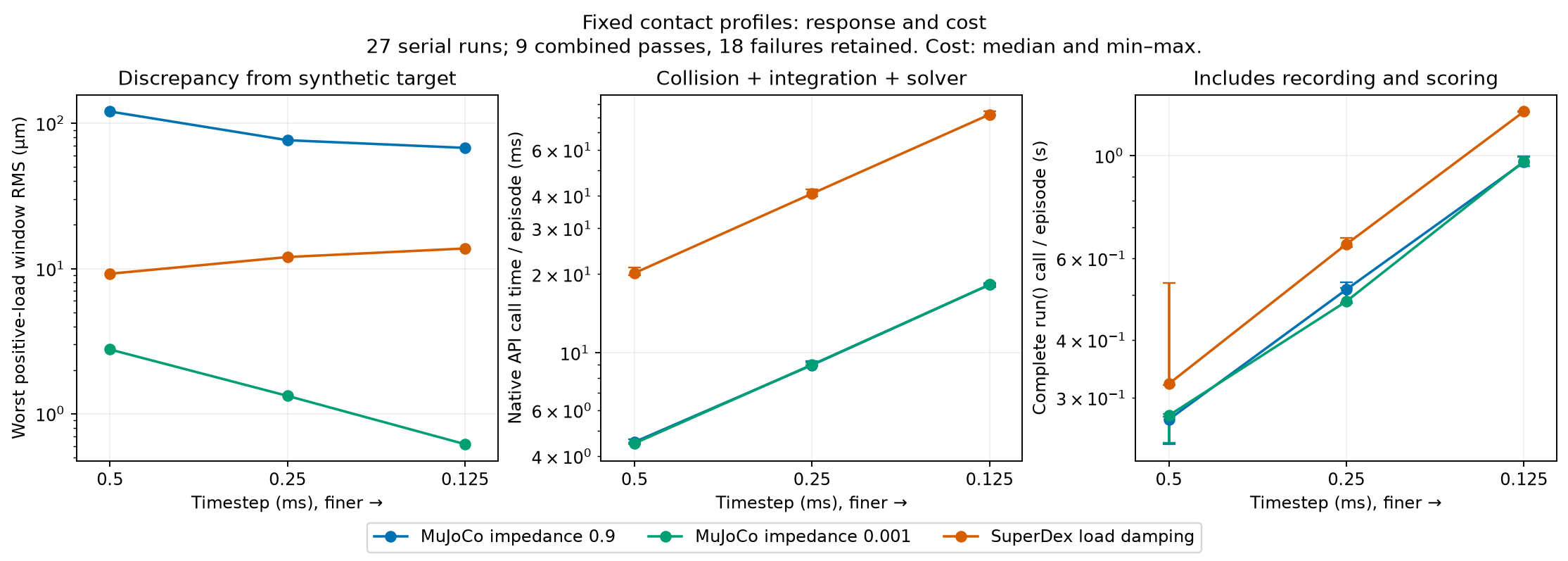
All 27 fixed-profile, three-timestep, three-repeat episodes were independently rescored: nine original combined passes and eighteen retained failures. Worst positive-load window RMS decreases from 2.771 to 0.617 µm for the low-impedance MuJoCo profile; it increases from 9.209 to 13.751 µm for the current SuperDex load-damping profile, which fails unloading no-tension checks at every timestep. The reference is a specified linear spring–damper, not calibrated material data.
Paired mass and size transfer#
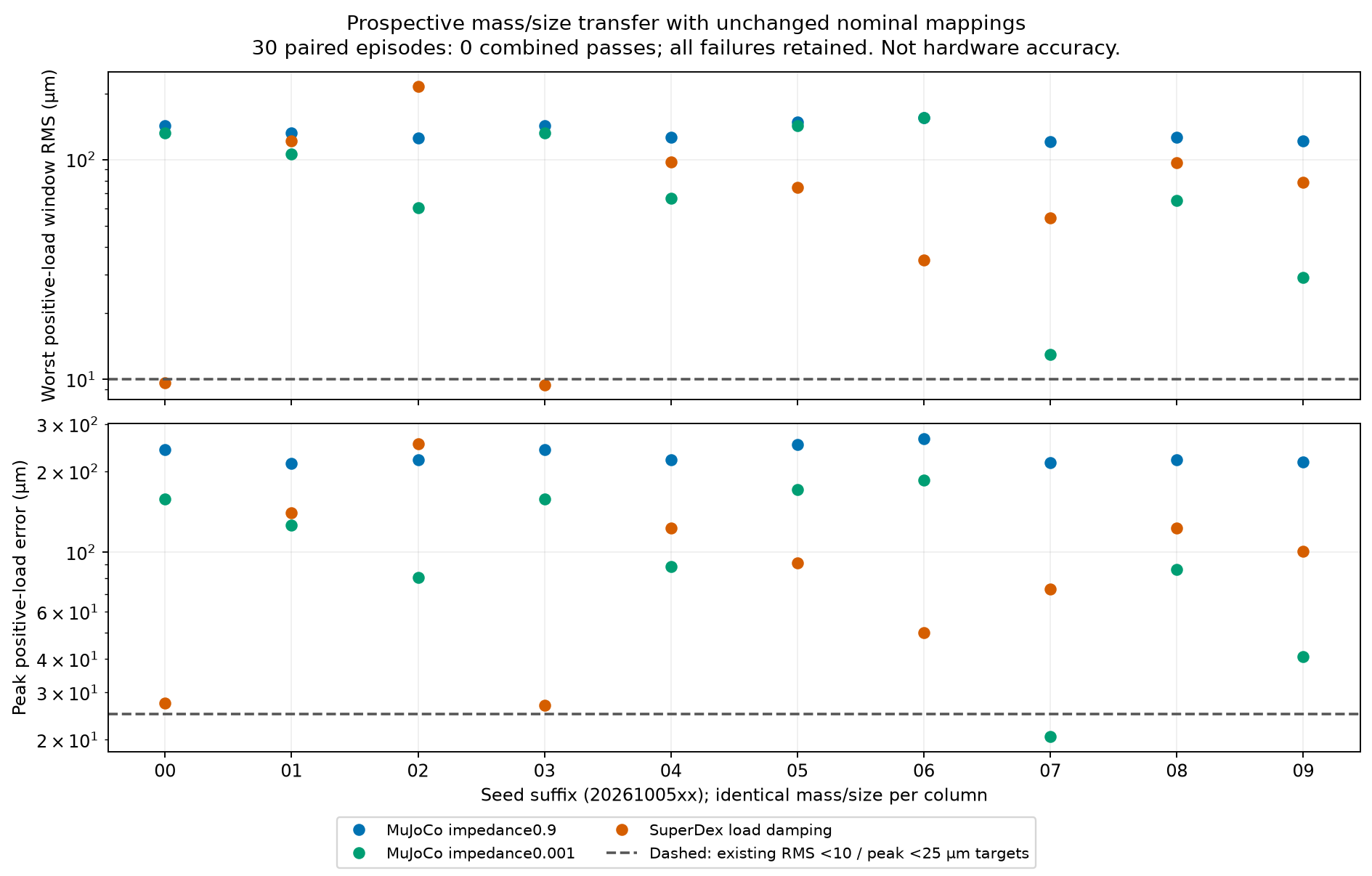
Three frozen nominal contact profiles completed30 episodes over10 preregistered mass/size combinations: original engineering checks1/30, transient target0/30, combined0/30. All outcomes independently reproduce; all30 actual initial states and representation checks within the declared scope are complete. Nominal-scene success does not establish parameter transfer. No mass/area compensation was applied; failures show that these mappings miss the synthetic target, not that native algorithms are wrong. Internal cooking and combined-law observability remain incomplete.
Native normal-response identification#
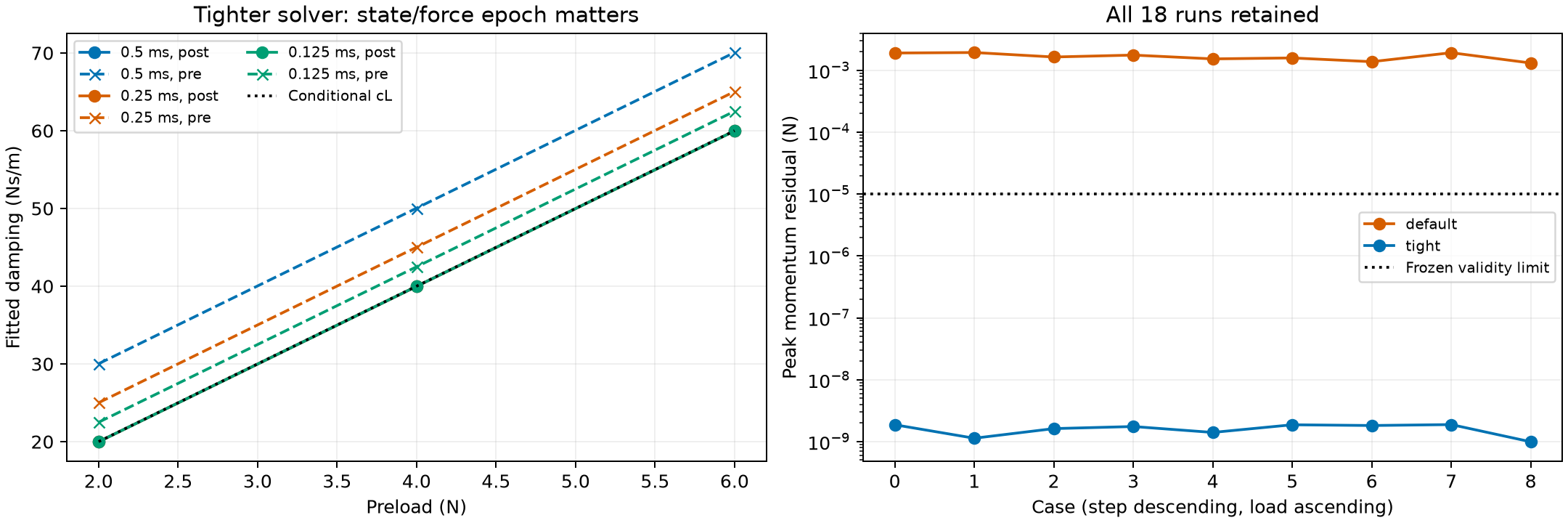
Nine predeclared preload/timestep cases isolate local stiffness and damping with two-tone forcing and smaller-amplitude validation. The default solver batch failed the fixed momentum-residual gate in every case. A controlled tighter-solver batch preserves all physical inputs and acceptance thresholds: 9/9 valid records, local damping near 20/40/60 Ns/m at 2/4/6 N. Material calibration remains incomplete. Protocol and all outcomes.
Applied-load response#
Nine low-impedance cases pass data validity; nine high-impedance cases fail settling and remain rejected. The local fit separates load feedthrough from state coefficients; this is not completed material calibration.
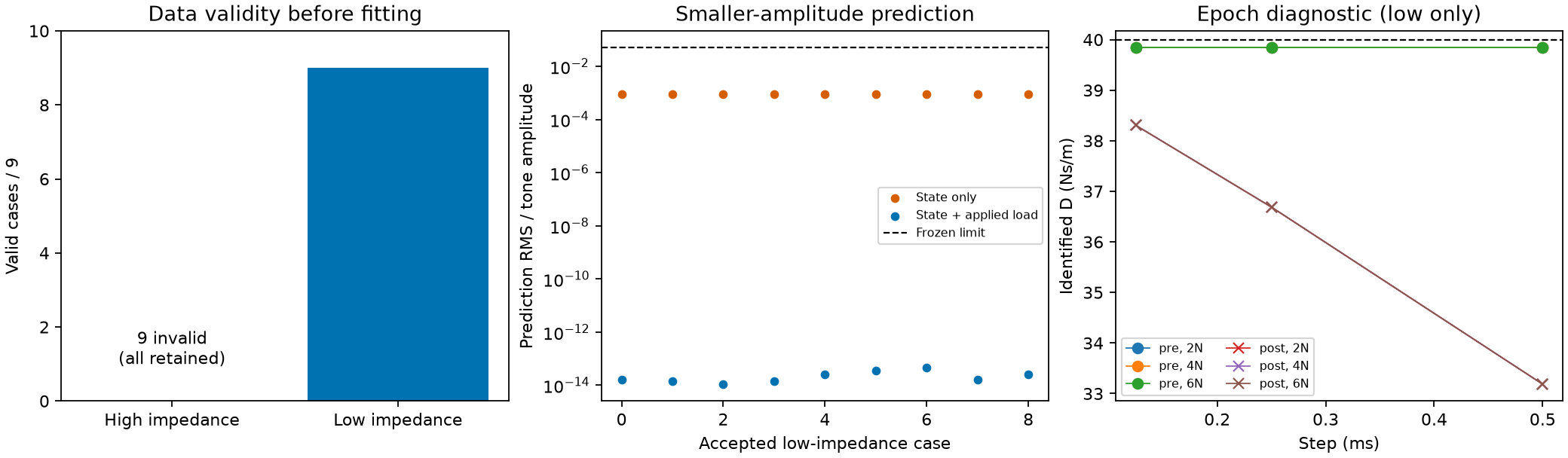
Contact diagnosis synthesis#
Static matching has not established a shared dynamic material. All30 paired transfer cases fail the combined target; local force-law identification does not repair unloading. Requirement-by-requirement evidence and open commitments. Issue10 remains open; this summary adds no new experiment or engine ranking.
Contact-onset configuration sensitivity#
All 24 fixed settings + 2 exact repeats pass engineering checks; the cone effect changes direction across settings. Passing is not material accuracy. Complete figures, protocol and metrics.
The original six damping archives now support optional point-level diagnosis with unchanged historical scores. No local tension was hidden by the aggregate in this cohort; this is neither a new physics experiment nor an unloading repair. Point-level report.
UniSim candidate: bounded paired qualification passes; production ownership remains native