Experiment catalog#
The 16-case block force-limit experiment is complete: 0.2/0.4 N fail retention, 0.8/10 N hold and release, including ±2 mm offsets. Numerical validity and task outcome are separate; no hardware-fidelity claim.
Keep existing code paths to preserve asset references, reproduction commands and historical evidence. Each experiment connects a question, configuration, raw record, independent score, report and failures.
Experiment |
Code |
Question and status |
|---|---|---|
The original uses compliant latch constraints to carry the sponge with the hand; matched no-latch runs measure contact-only holding, slipping and cleaning |
||
Three tofu pieces and four banana pieces; explain separation through recorded knife-contact forces, using synthetic materials |
||
Two shallow cuts and a connected base; distinguish elastic rebound from native cut history |
||
Single-cut CPU TLMPM, dynamic blade reaction and separation after withdrawal; independent BladeMaster reference |
||
Apple stem grasp |
OpenArm + Wuji SDF-SDF frictional holding; distinguish default cases and historical perturbations |
|
Robot cloth grasp |
Pinch, lift and release; historical intersections retained; one repaired 9 s development case passes, robustness untested |
|
Contact and drives |
Sliding, loading/unloading and transients; synthetic response is not hardware calibration |
|
Basic cloth |
Stretch, drape, collision and falling folds; separate material/solver capabilities |
|
PhysX |
Native rigid bodies, SDFs, joints and surface cloth; one success does not establish held-out performance |
|
Genesis |
Scoped rigid evidence in #42; PBD cloth diagnostics retain failed momentum/grasp checks; tested frictional grasp profile rejected; equal-time response, connected folds and two held-out offsets recorded |
src/dexlab/ contains shared task registration, scoring and recording. scripts/ contains setup, rescoring, documentation and research tools. Share code only for real duplication or invariants; this is not a new general simulation framework.
Apple control and dynamics#
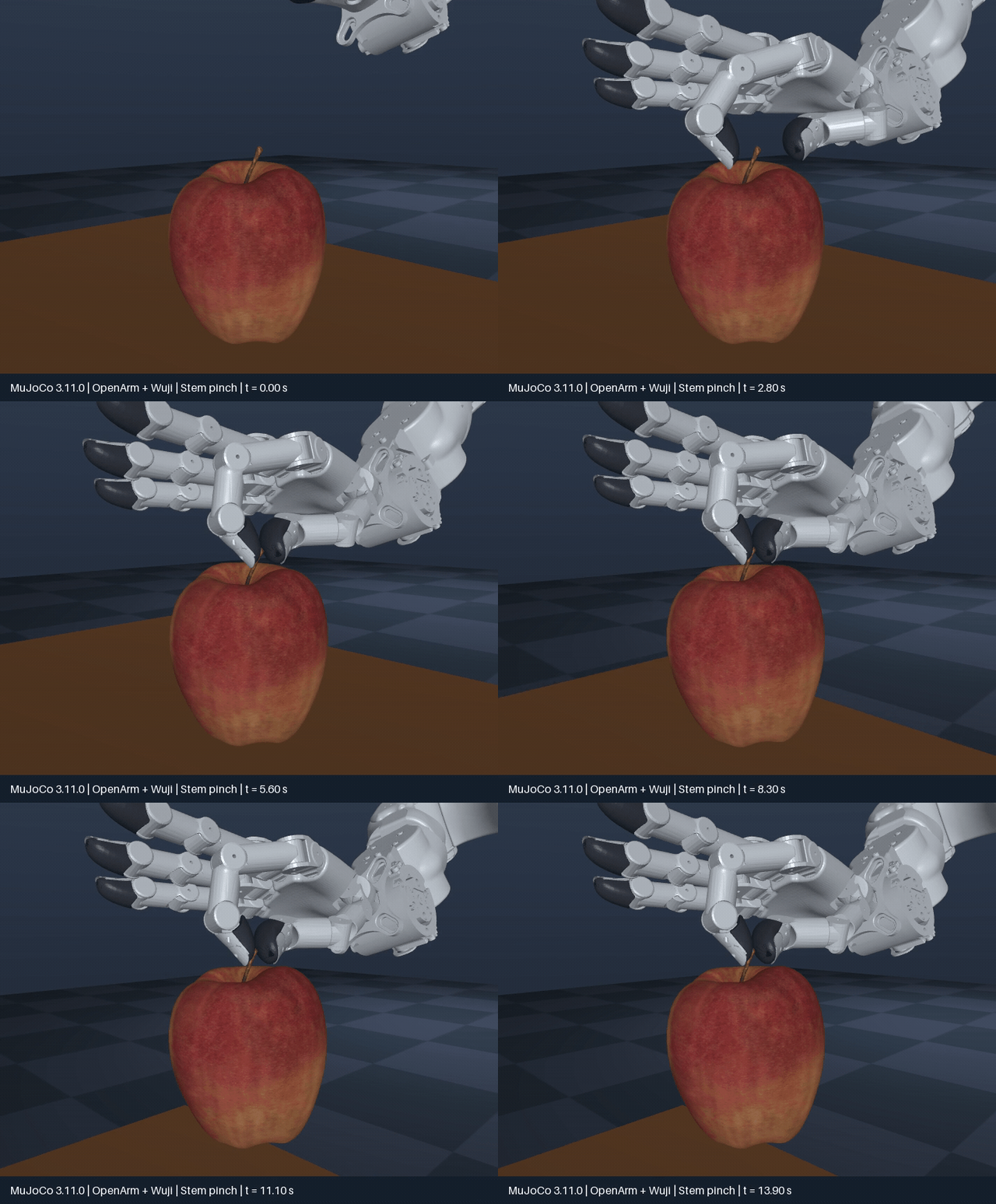
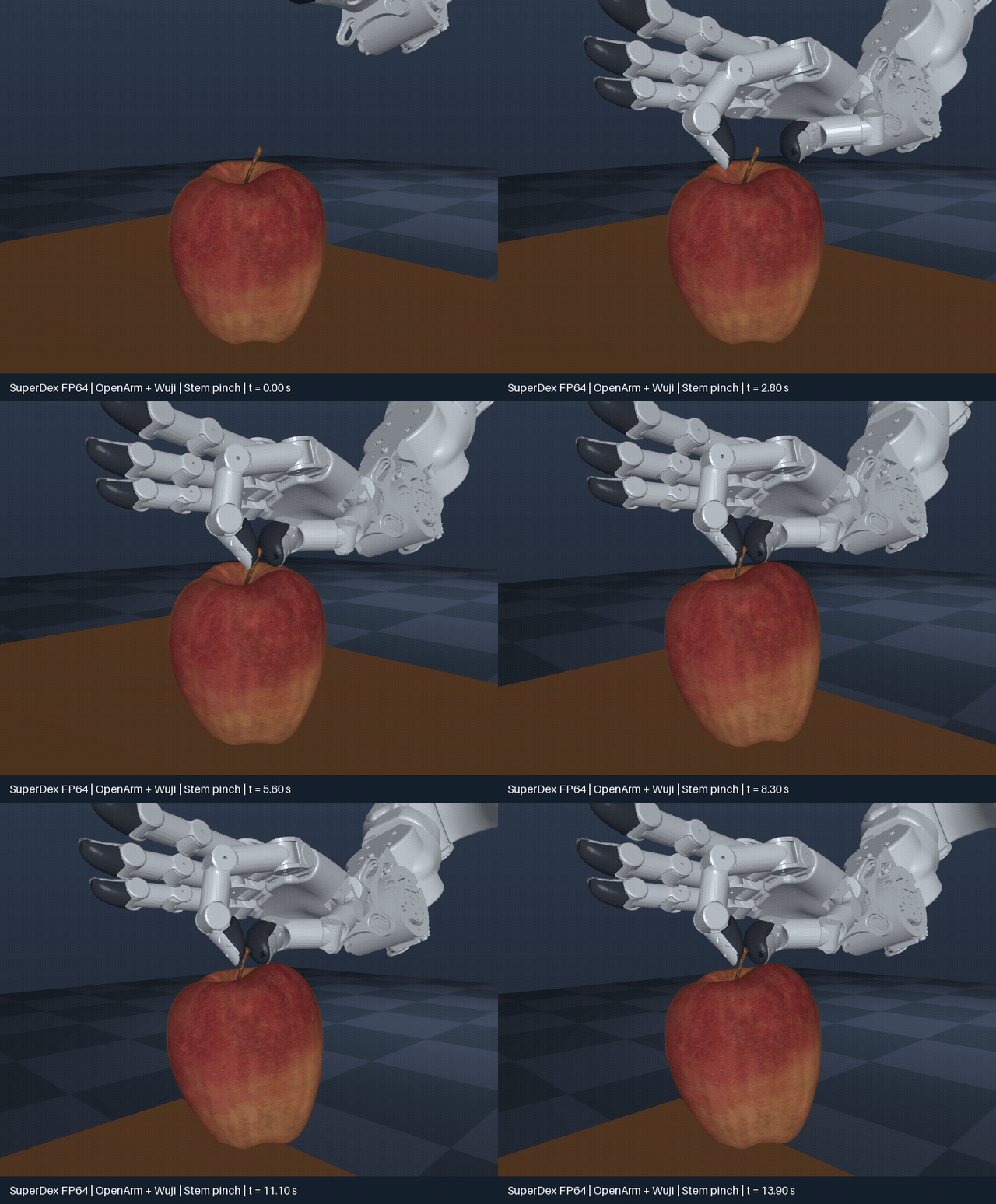
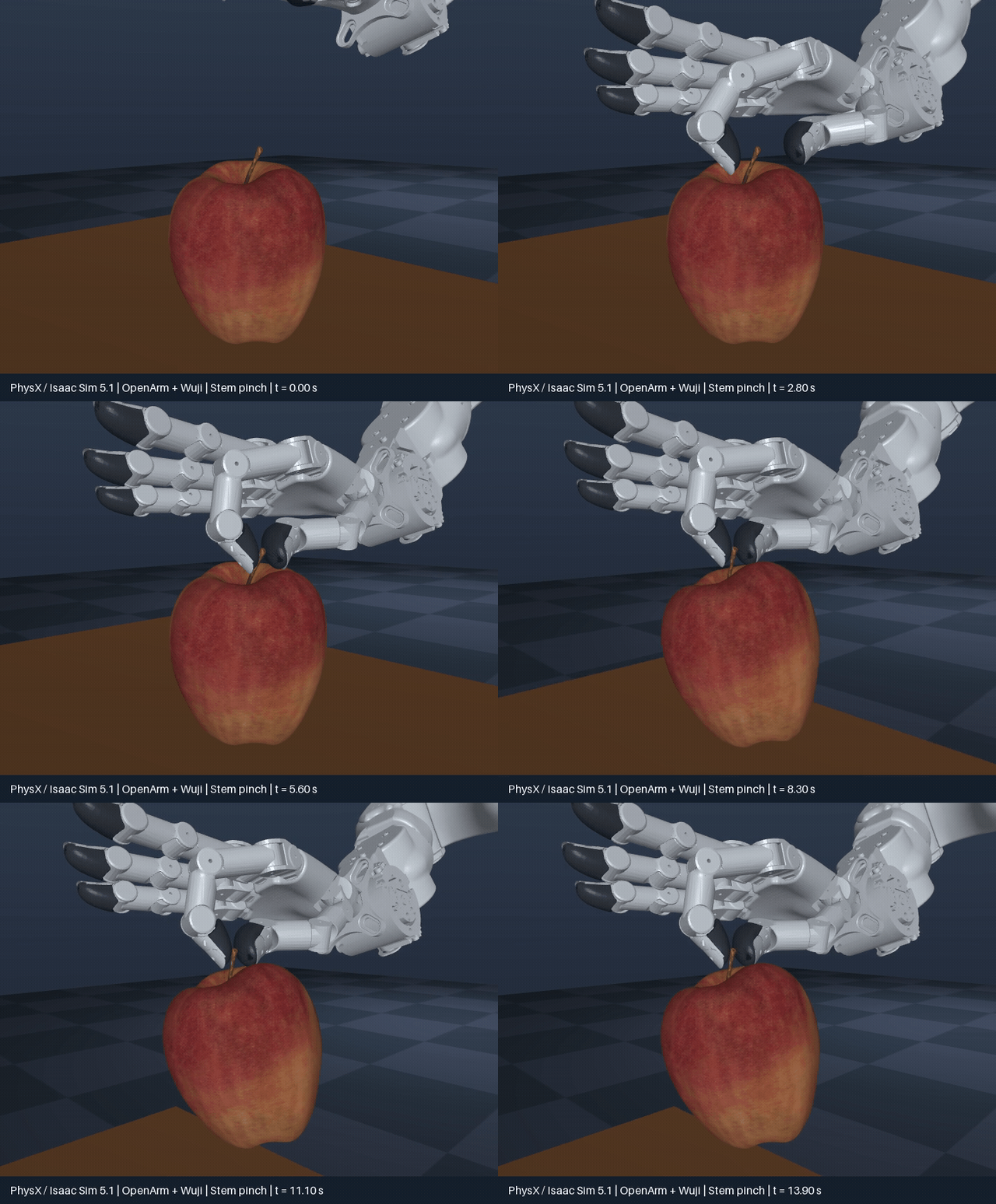
The right thumb/index pinch the stem while the left arm remains parked. Apple and stem form a 0.2 kg free rigid body. Known poses, IK and fixed joint targets drive the robot; the engine integrates actual object motion without attachment or object-position actuation. The continuous hold window is 11–14 s, with fruit contact allowed during approach.
The display camera follows recorded apple poses for playback only. There is no validated visual controller, stem fracture or hardware accuracy claim.
Continuous close-up records#
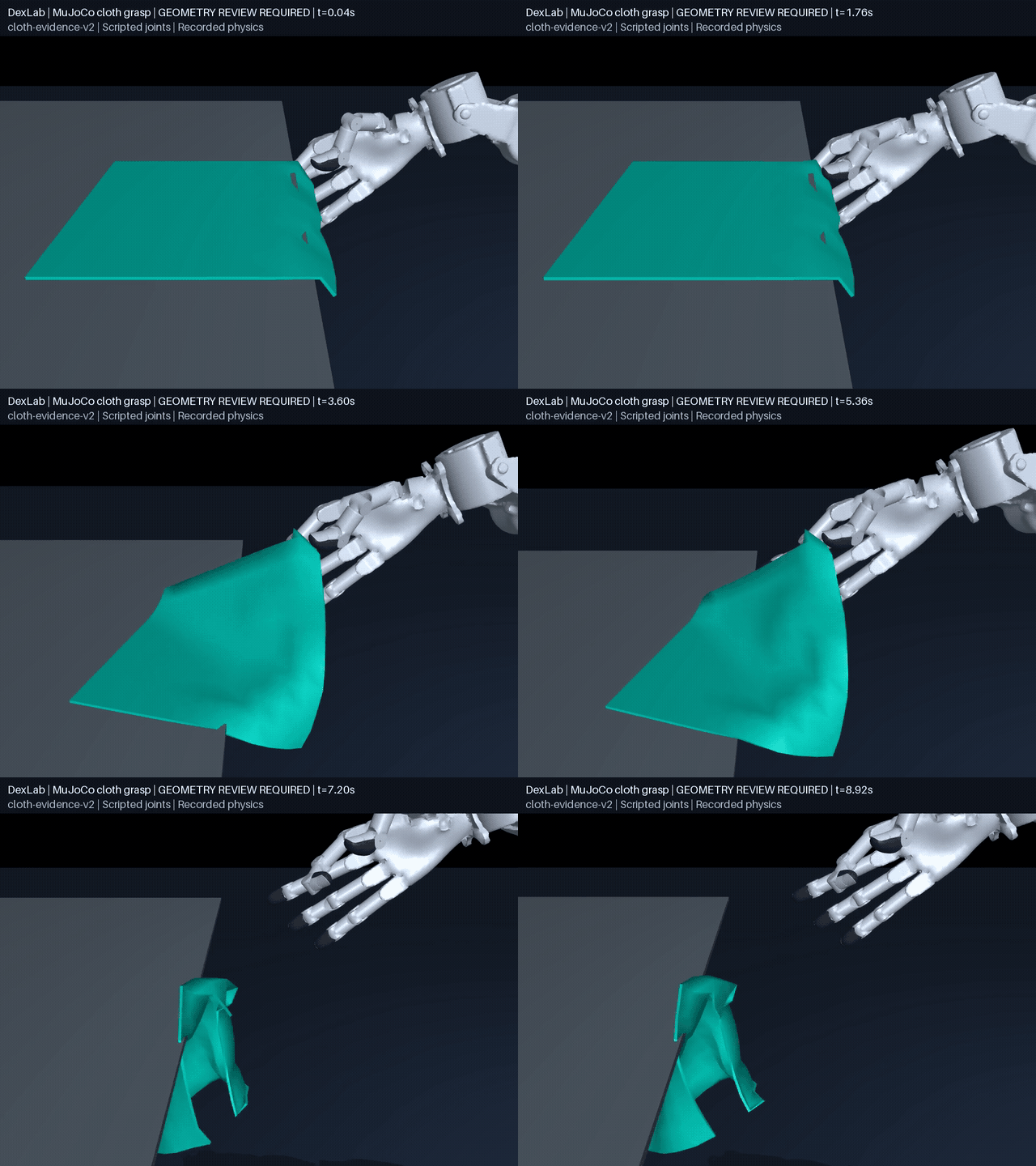
These are development-scene replays at the original pinned versions, not held-out success rates. The cloth recording preserves the detected table-intersection failure.
Hardware acquisition preparation#
The protocol, empty template and log validator cover two UR7e arms and two identical CTAG2F90D grippers. Commands, measured feedback and independent references remain separate; unknown data stays unknown. The tool only reads files and does not control hardware. Format validity does not establish calibration.
Friction response development#
The 16-run planar report retains all paired MuJoCo 3.14.0 / SuperDex FP64 outcomes, measured initial states, speed-bin force ratios and costs. Every run passes existing plane checks, while low-speed resistance differs. This is not matched material calibration or an engine-accuracy ranking.
Repaired cloth development case#
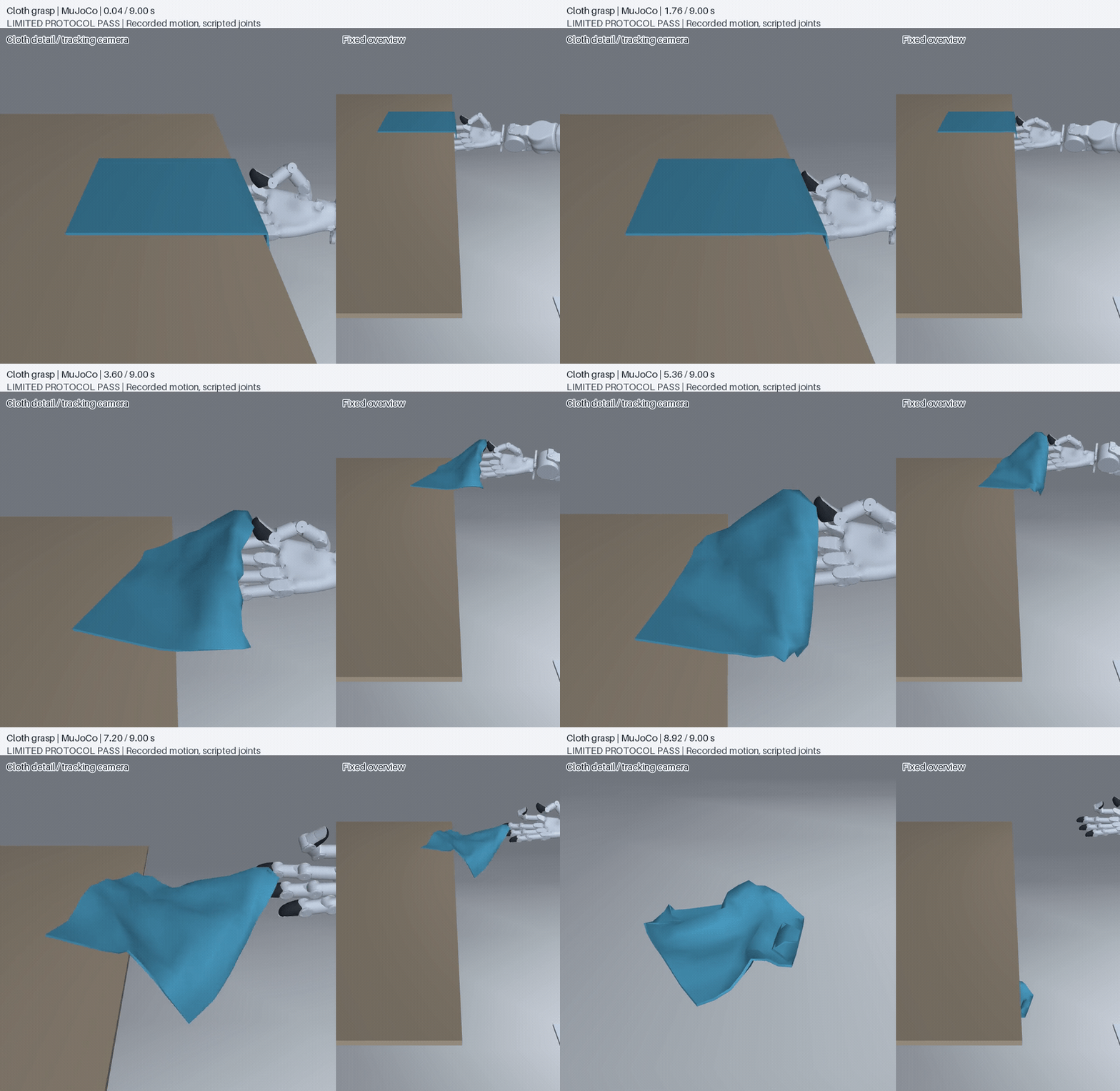
One 9 s candidate passes the fixed v3 criteria; self penetration remains close to its limit. Metrics, failed controls, video provenance and exact command. This does not replace the historical failure above or establish robustness.
Initial Drake incline qualification#
Official 1.57.0 / SAP / kLagged / hydroelastic: all six static and frictionless cases pass, three sliding cases fail, and the no-floor negative is rejected. The original coplanar failure is retained; 1 µm clearance belongs to a separate protocol. Reliable coverage under the new protocol remains unqualified. 报告 / Report.
Full experiment and historical index#
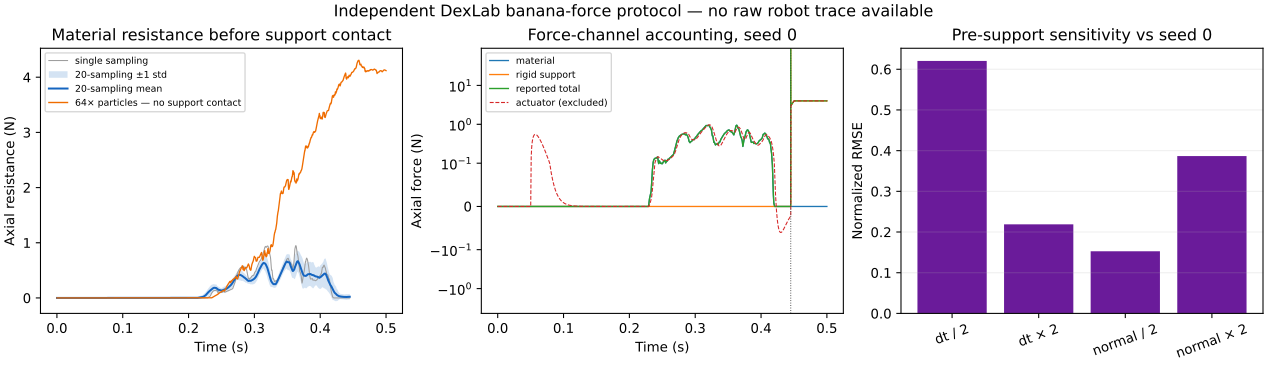
Banana single-cut force: 20 samplings and 64× particles
CPU TLMPM / independent paper-value protocol
Is material resistance stable across sampling, timestep, contact scale and particle refinement?
Twenty baseline runs qualify numerically; the 64× case misses support contact within 0.5 s and gives 2.051 RMSE, so convergence and real-force accuracy remain unsupported.
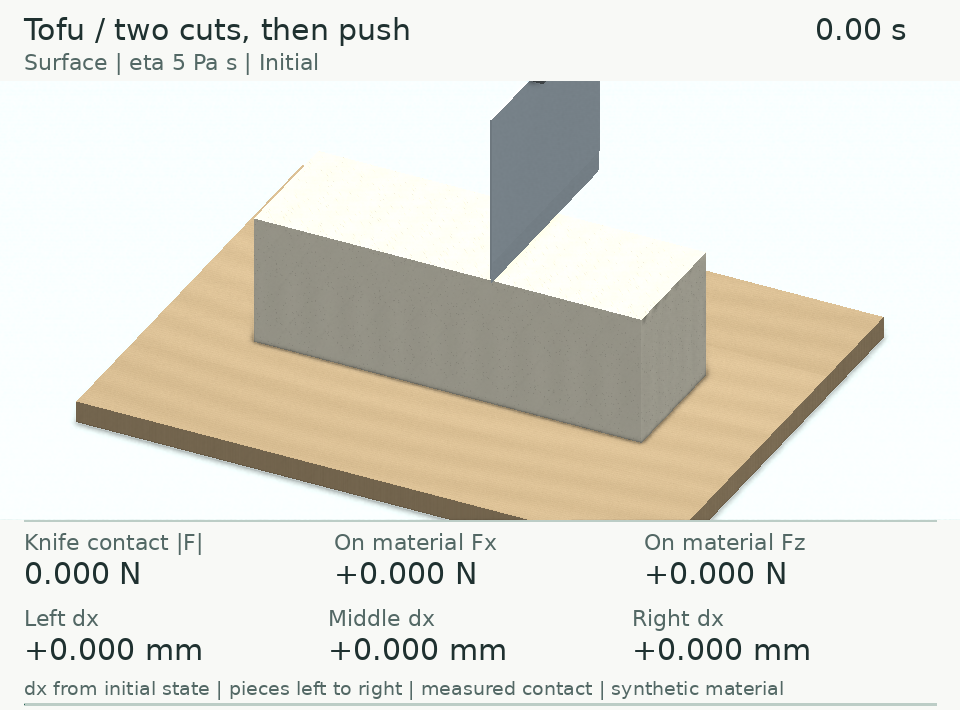
Final cut directly into a side push: tofu and banana
CPU TLMPM / measured knife contact
Does visible blade-face contact drive the final piece apart?
Three tofu pieces and four banana pieces; the final cut transitions directly to a face push, displaying contact force and motion. Tofu adds Newtonian viscosity with retained elastic, half-step and no-push controls.
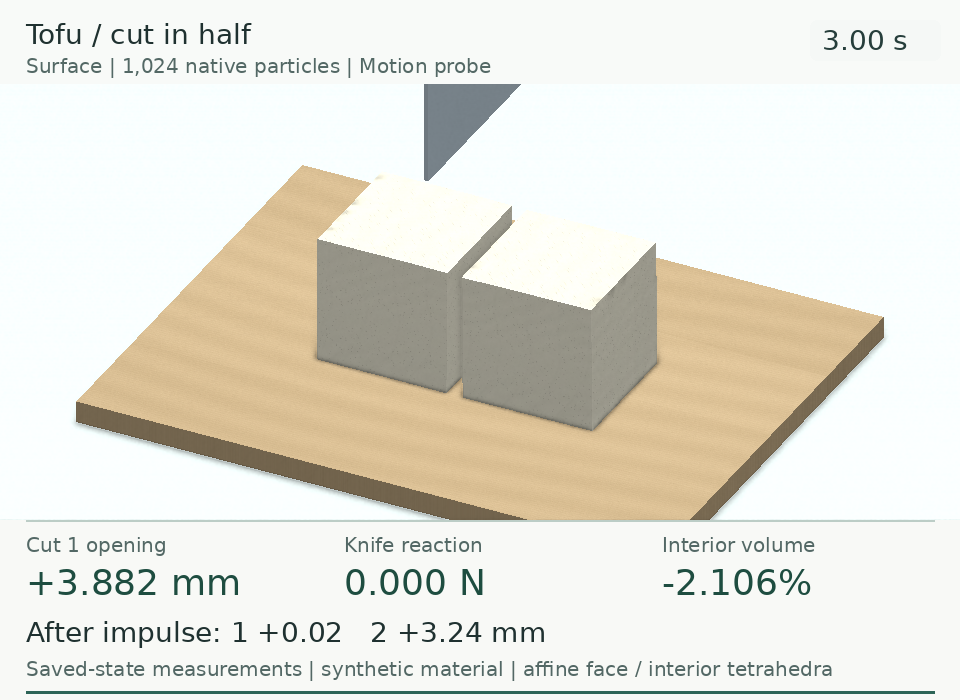
Historical: Synthetic tofu halving
CPU TLMPM / BladeMaster v2 reference
Do the two cut pieces move independently after withdrawal?
Three full-cut cases yield 50% mass pieces; negative controls stay connected. Force convergence and real-tofu calibration are unproven.
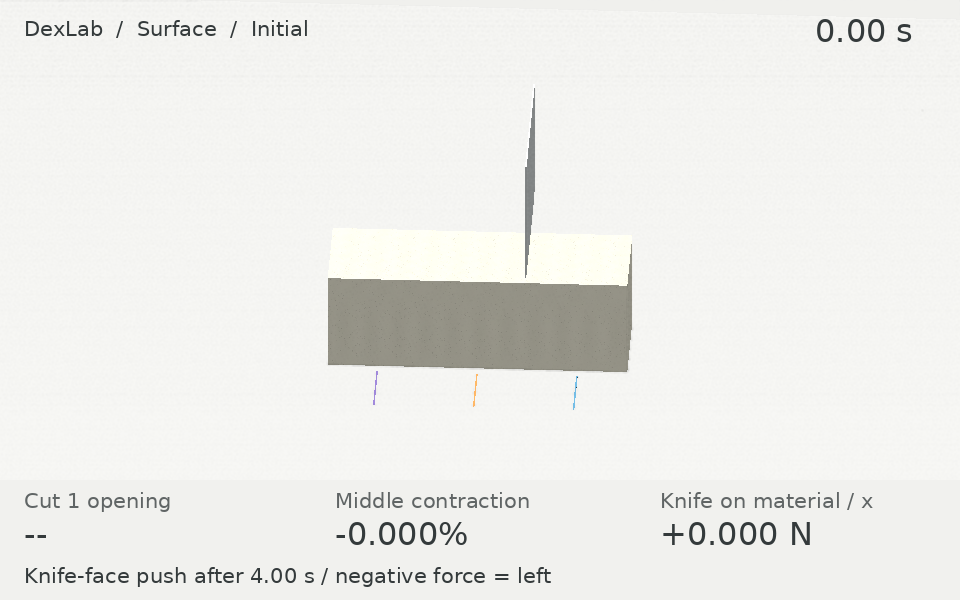
Historical: Two tofu cuts: three-method view
CPU TLMPM / author reference videos
Can the left piece move independently after two cuts?
Two cuts form three pieces; native knife contact pushes the left piece, with measured force and displacement. Author clips use a final velocity input, so inputs differ.
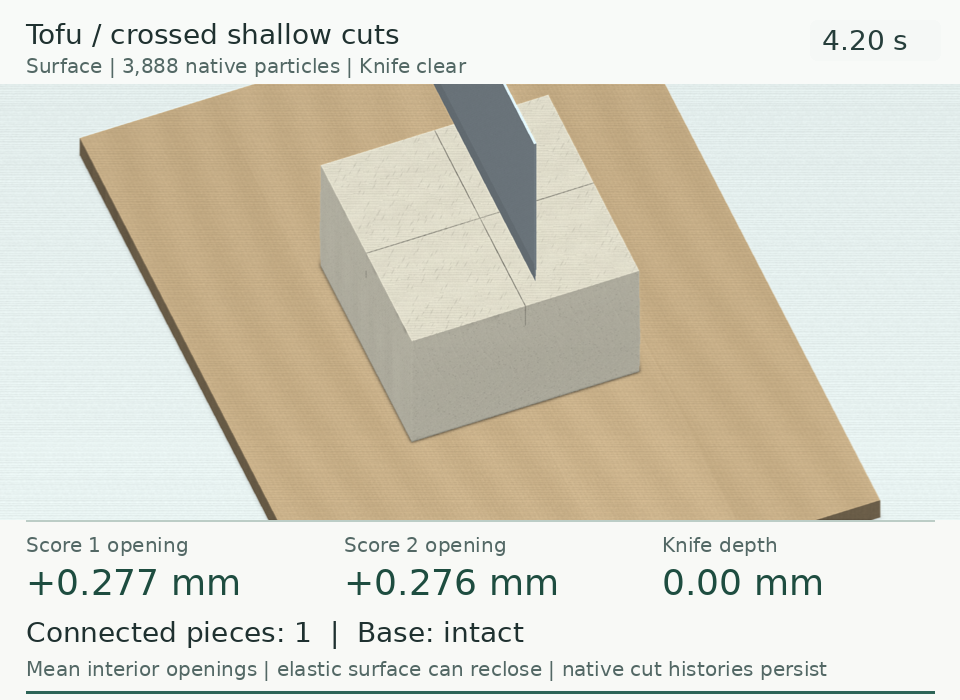
Crossed shallow tofu cuts
CPU TLMPM / guided orthogonal scoring
Does the lower bridge remain connected after crossing incisions?
Default and half-step cases form two shallow cuts while retaining one native component; the uncut control is rejected. Synthetic material, not food calibration.
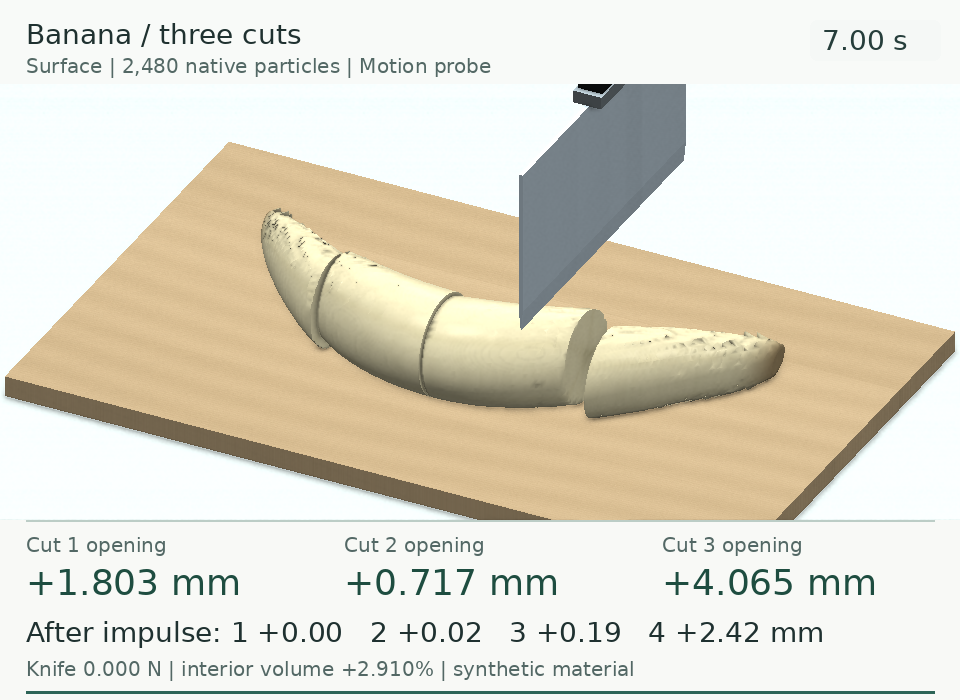
Historical: Three sequential banana cuts
CPU TLMPM / persistent cut history
Do subsequent cuts preserve earlier discontinuities?
Progressive separation and complete controls in the experiment record. Surface/particles share physical states; no real-banana calibration.
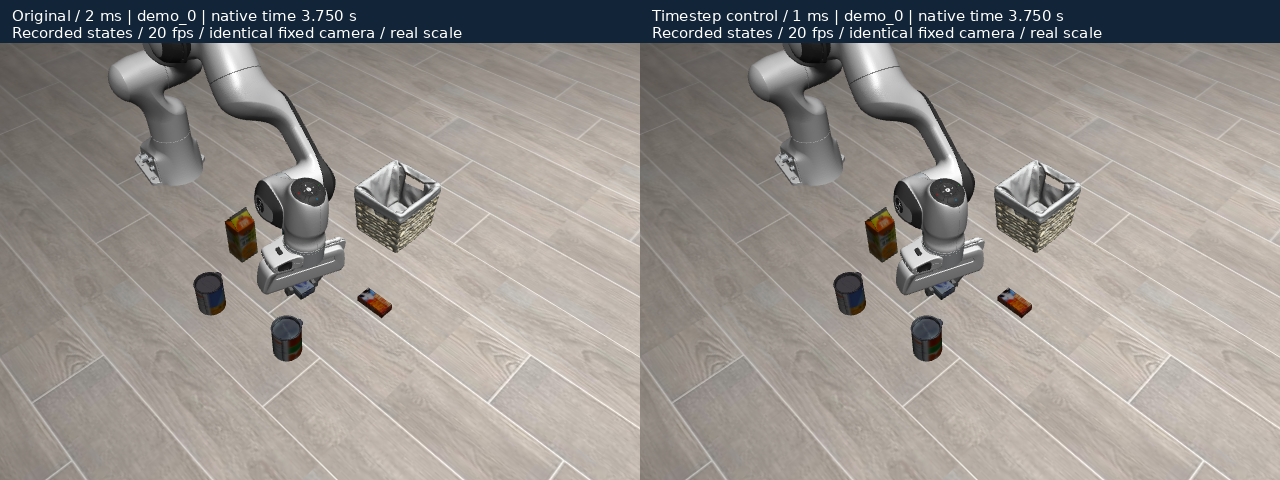
Native LIBERO: diagnosis and change
LIBERO / robosuite 1.4.0 / MuJoCo 2.3.7 · Newton / elliptic
How can an existing benchmark expose and validate a change?
Stale observations identified; timestep trials retain successes, failures and regressions.
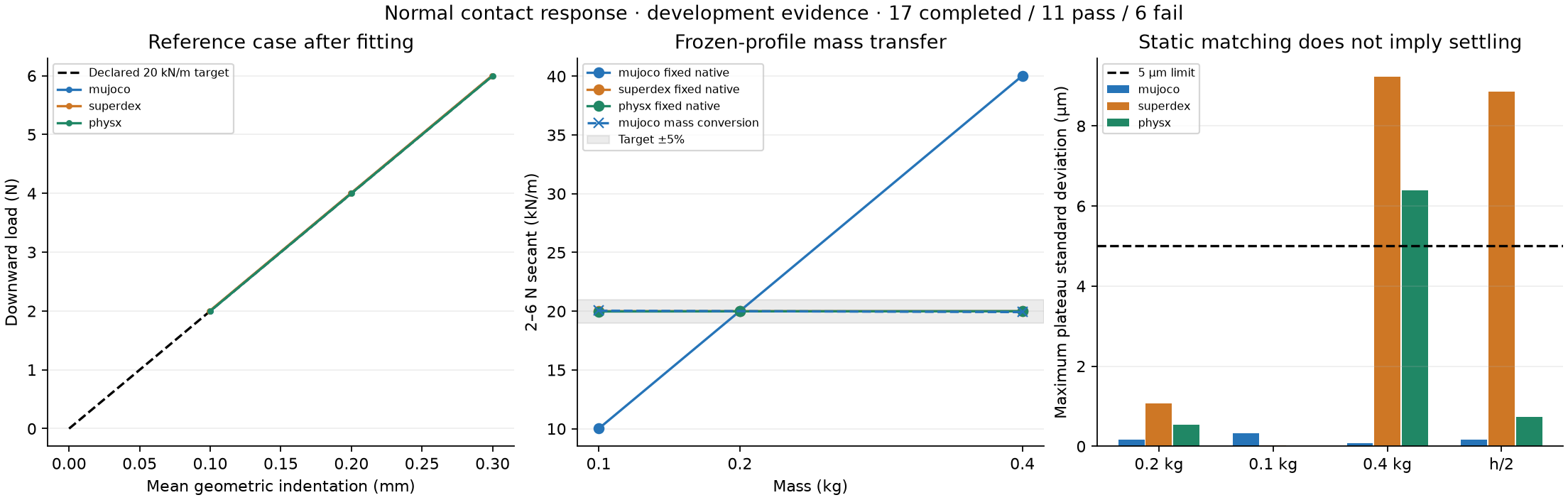
Normal & transient response
MuJoCo · SuperDex · historical PhysX
How do parameters change loading, unloading and transients?
Static calibration works; dynamics and mass transfer need separate checks.
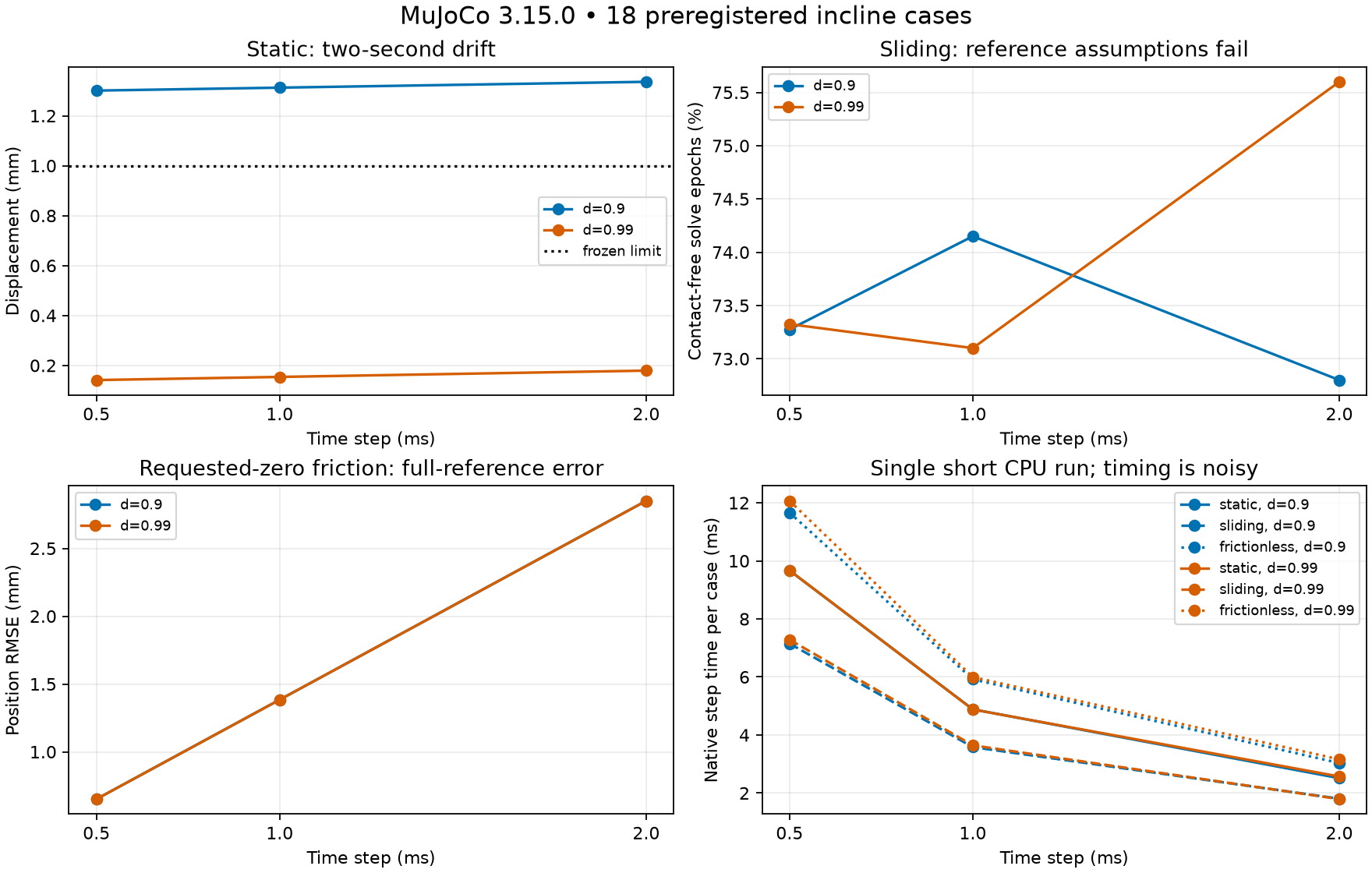
Six-engine incline & friction
MuJoCo · SuperDex · Genesis · Newton Physics · PhysX · Drake
Where do static, sliding and low-friction cases differ?
Fixed-profile outcomes and observation validity are separate; failures remain.
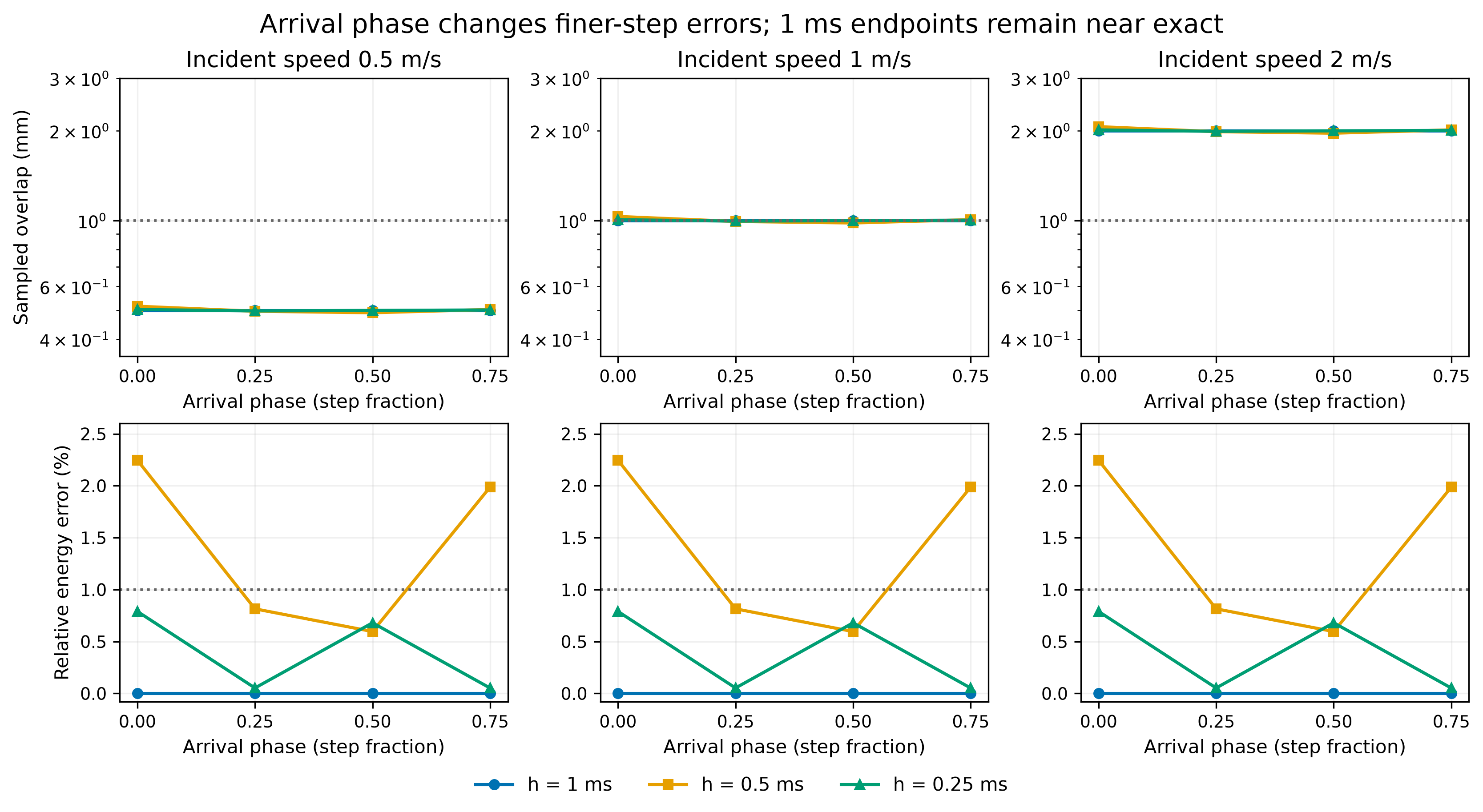
Impact & contact onset
MuJoCo · SuperDex
How do timestep, stiffness and impact phase affect transients?
Existing phase/stiffness sweeps; smaller steps do not automatically remove model differences.
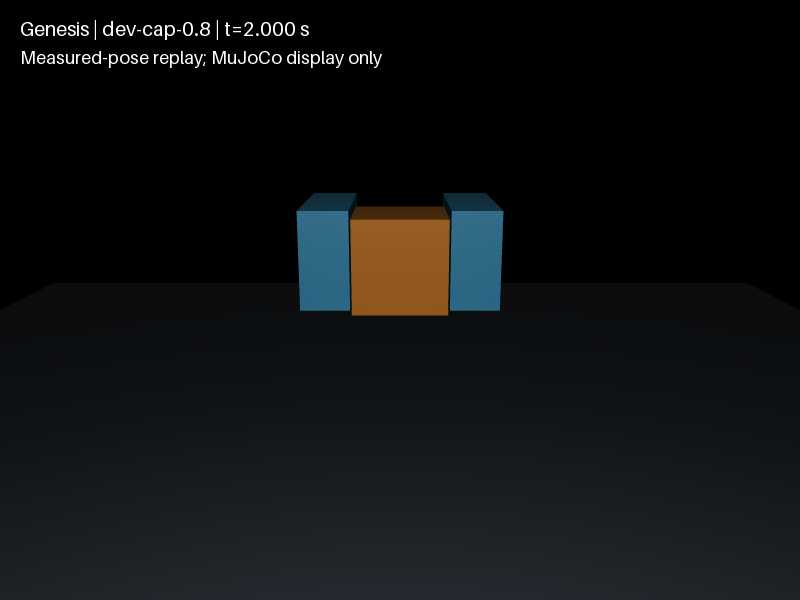
Fixture pinch, lift & release
Genesis · MuJoCo · SuperDex (separate protocols)
Why does the grasp hold or slip?
Genesis 0.4 N and 0.8 N configurations have different retention outcomes.
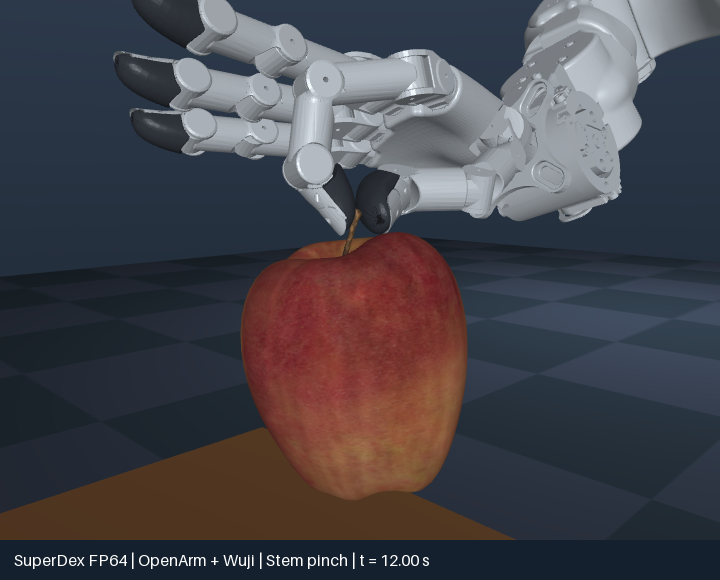
Apple-stem grasp · SDF contact
MuJoCo · SuperDex · historical PhysX
Can a grasp maintain contact on complex geometry?
Native continuous replays and historical independent checks; cohorts stay separate.
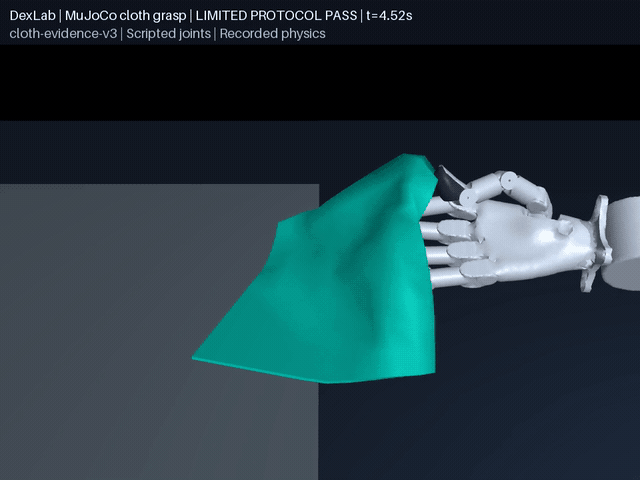
Cloth mechanics & robot grasp
MuJoCo · SuperDex · Newton Physics · Genesis · historical PhysX
When do deformation, contact and retention fail?
Historical compliant-grasp frame; mechanics, drop and grasp retain separate protocols and failures.
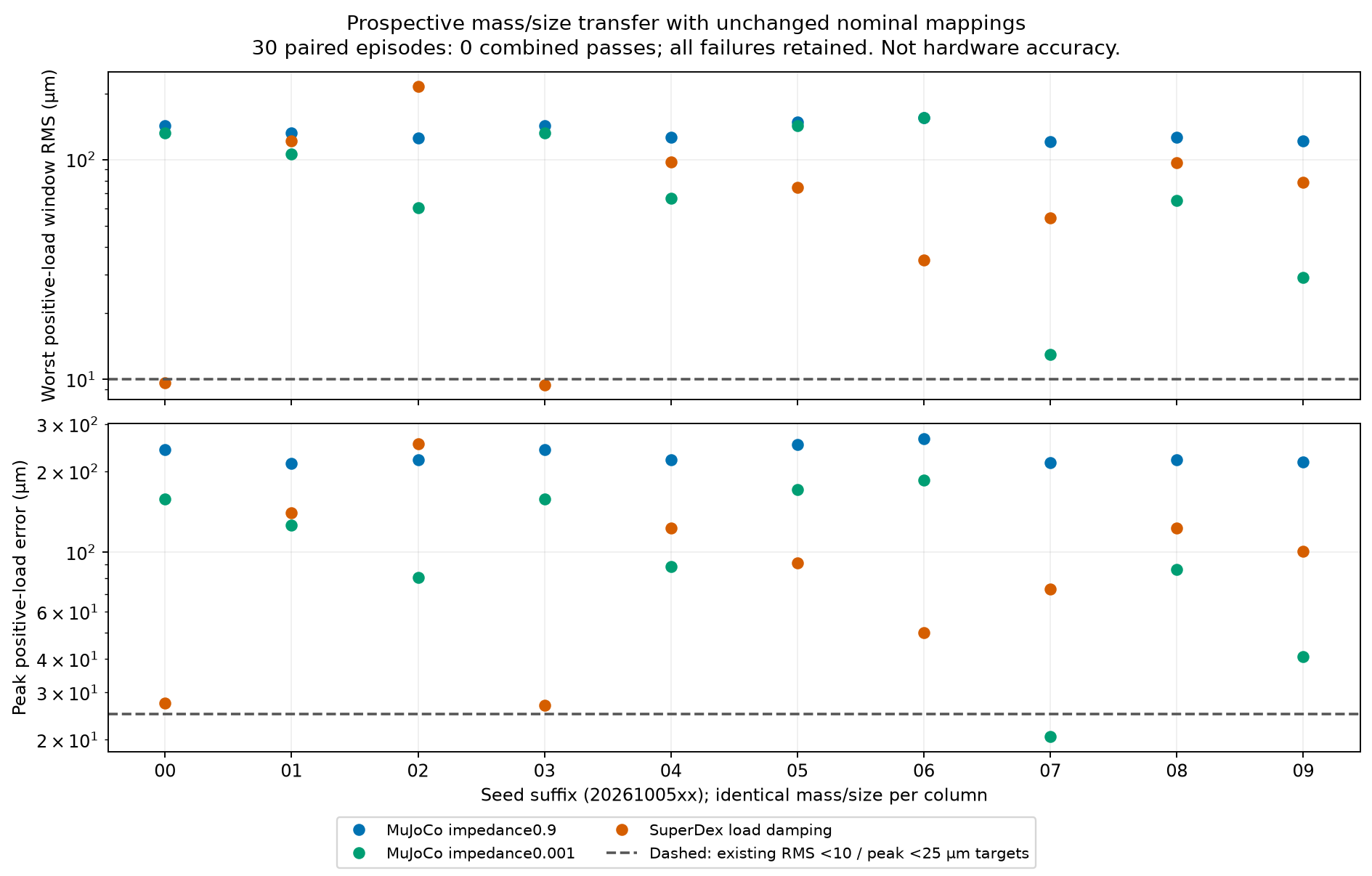
Mass / size transfer
MuJoCo · SuperDex
Do fixed parameters transfer to nearby scenes?
30 historical transfer records, 0/30 joint passes; failures guide selection.
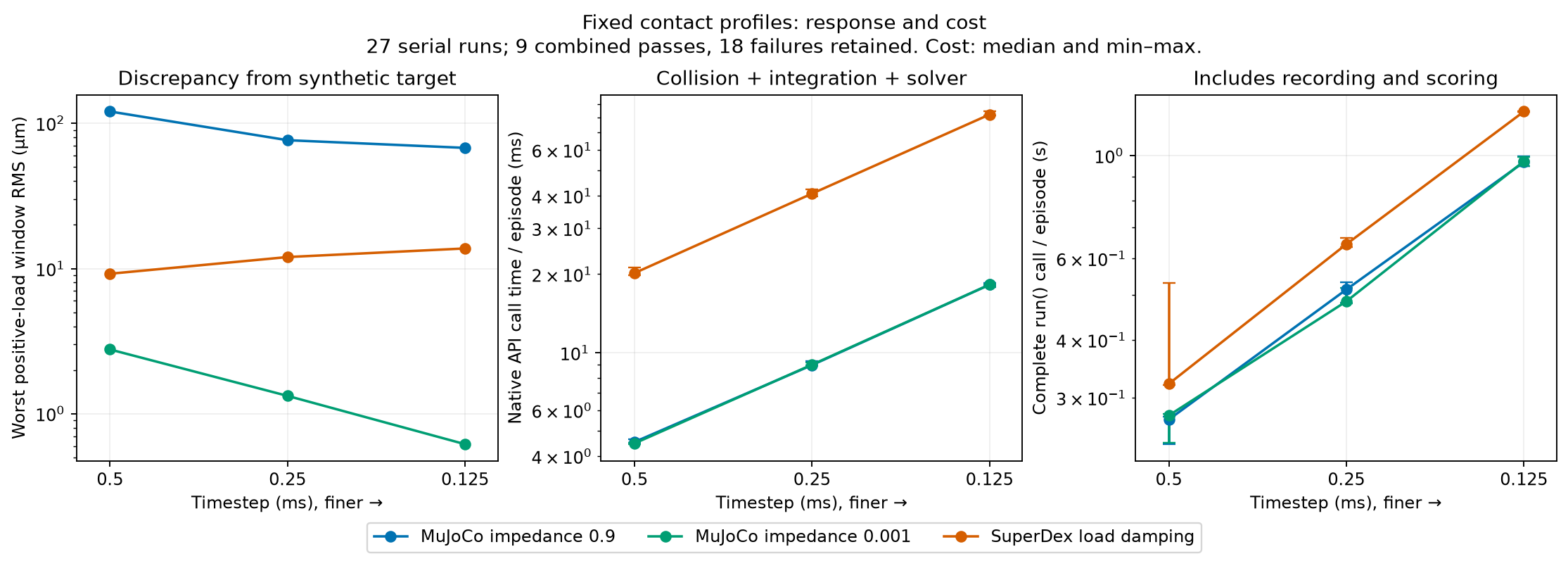
Response error & cost
MuJoCo · SuperDex
What does lower error cost?
27 records separate native computation, recording and scoring costs.
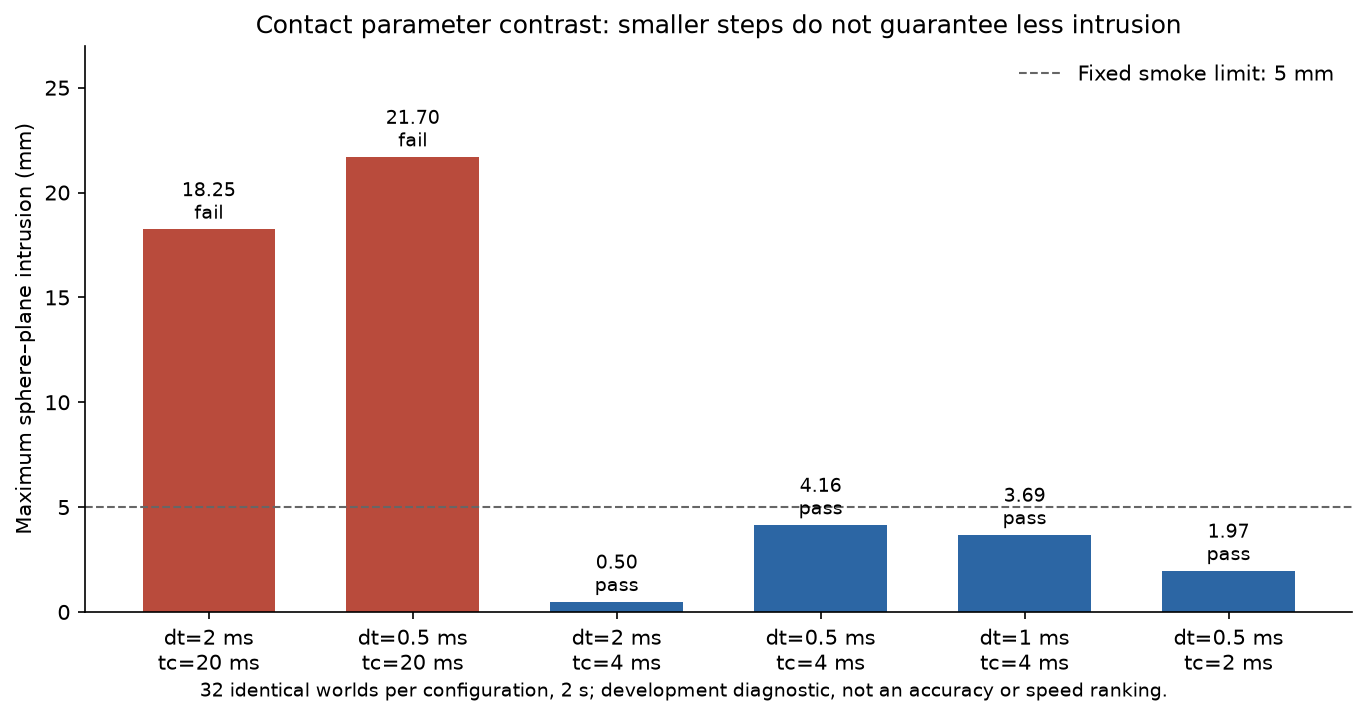
Native & framework paths
MuJoCo / MJWarp · Newton / Isaac Sim
Why can matching cores still produce different trajectories?
GPU field differences remain after CPU alignment; parameter-map thumbnail is not trajectory evidence.
Pending / incomplete: broader pushing, in-hand rotation, active folding and grasp transfer remain in their existing Issues. Existing knife-driven pushing has its own protocol; folded drop is not active folding.
What we already know#
Six-engine incline: shared conditions, different responses#
A 40 mm, 64 g cube; static, sliding and nominal-zero-friction conditions at three timesteps. Curves and replays retain the original passes, failures and invalid records.
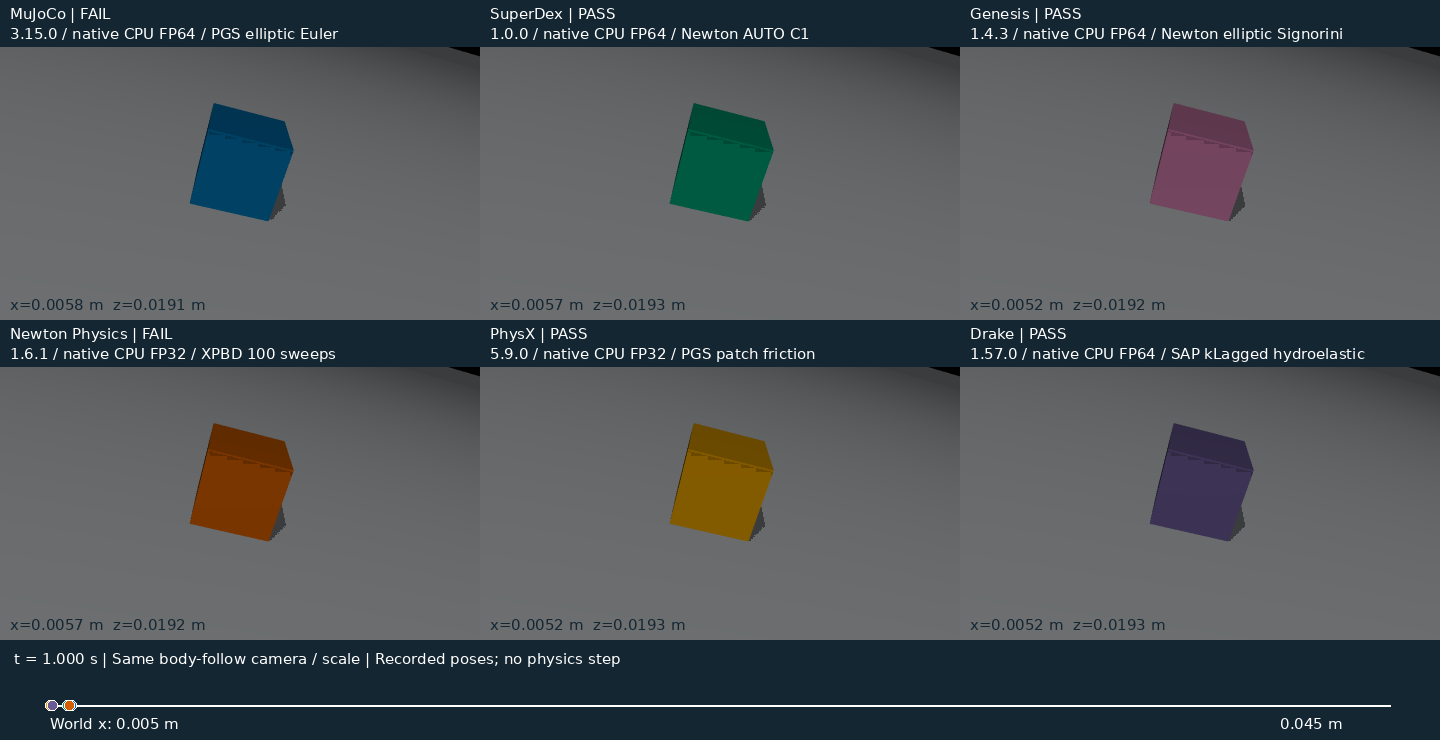
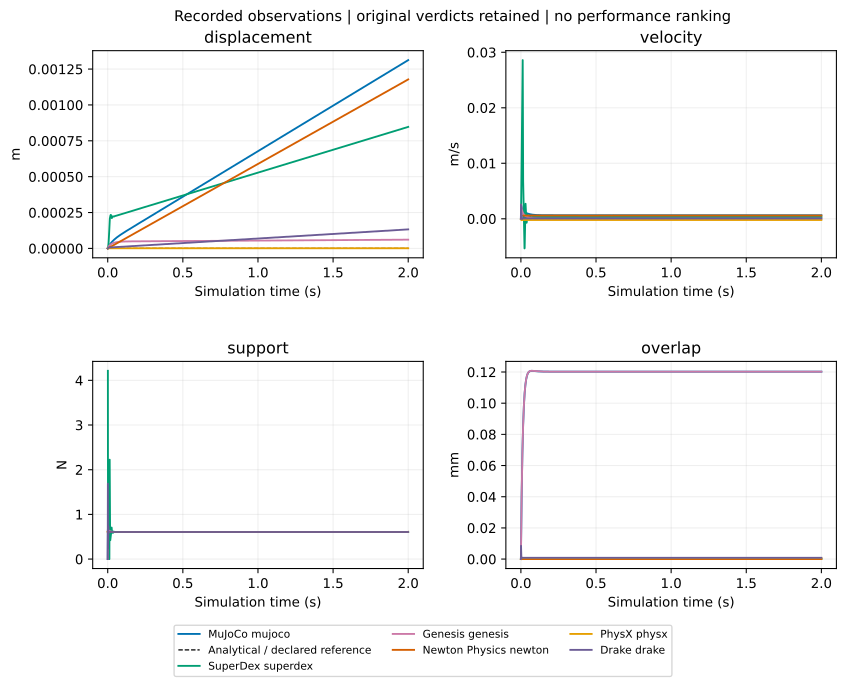
Synchronized replay, full-rate curves, parameters and original evidence
Normal response: change parameters or the solver?#
The same MuJoCo fixture moves from about 80 kN/m toward the synthetic 20 kN/m target. Inspect loaded-window indentation, then the complete unloading trace; success belongs to the stated checks and conditions.
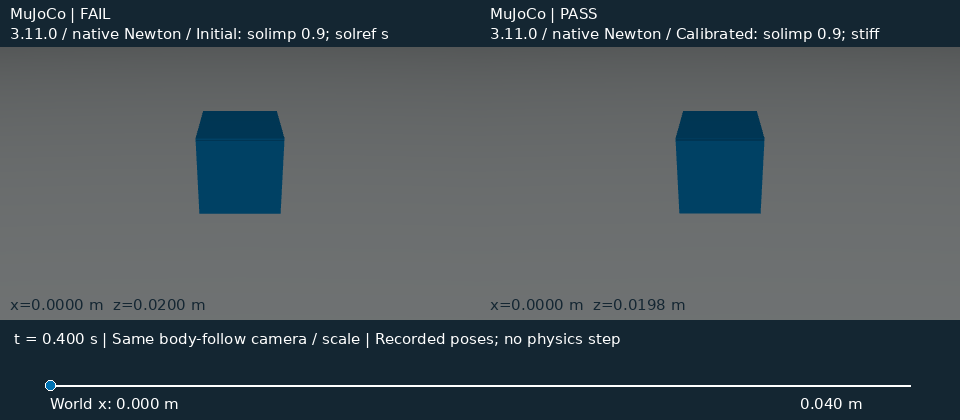
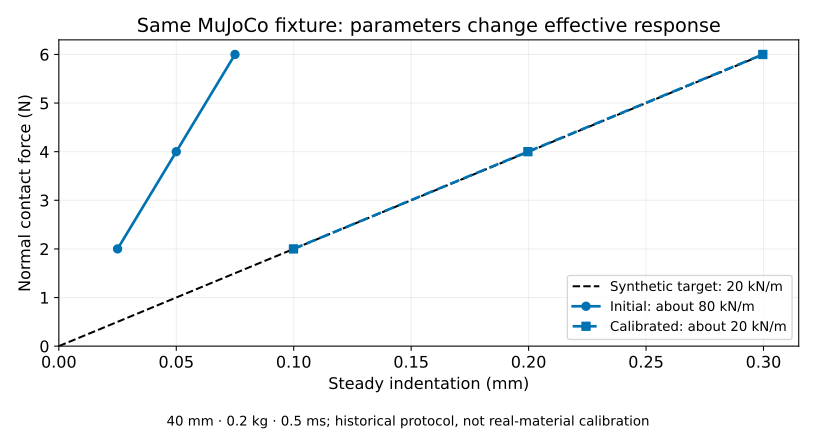
Synchronized replay, full-rate curves, parameters and original evidence
Pinch: 0.4 N slips, 0.8 N holds#
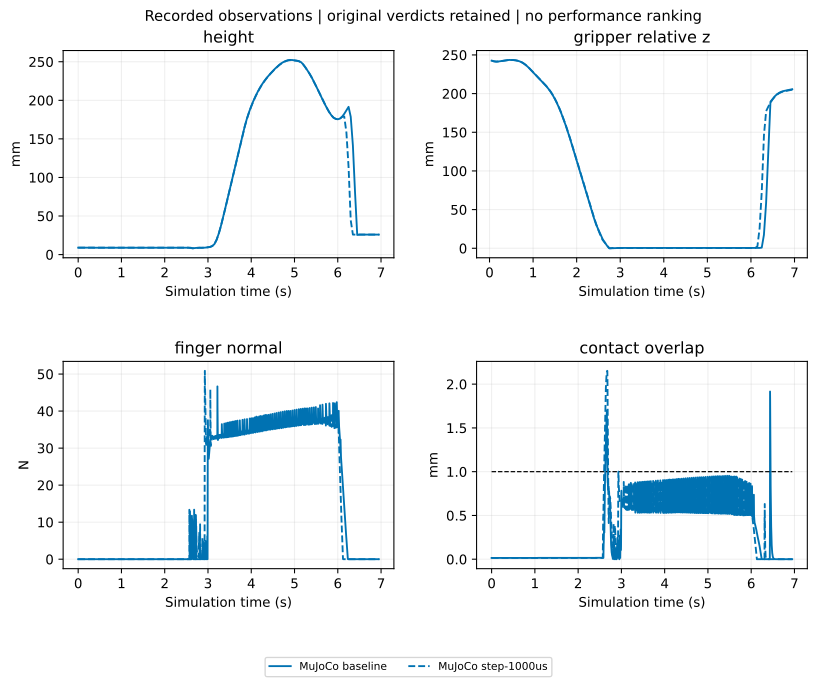
The same Genesis fixture and object, changing the finger-joint force limit. Compare complete closing, lifting, holding and release, with an open-gripper negative control retained.
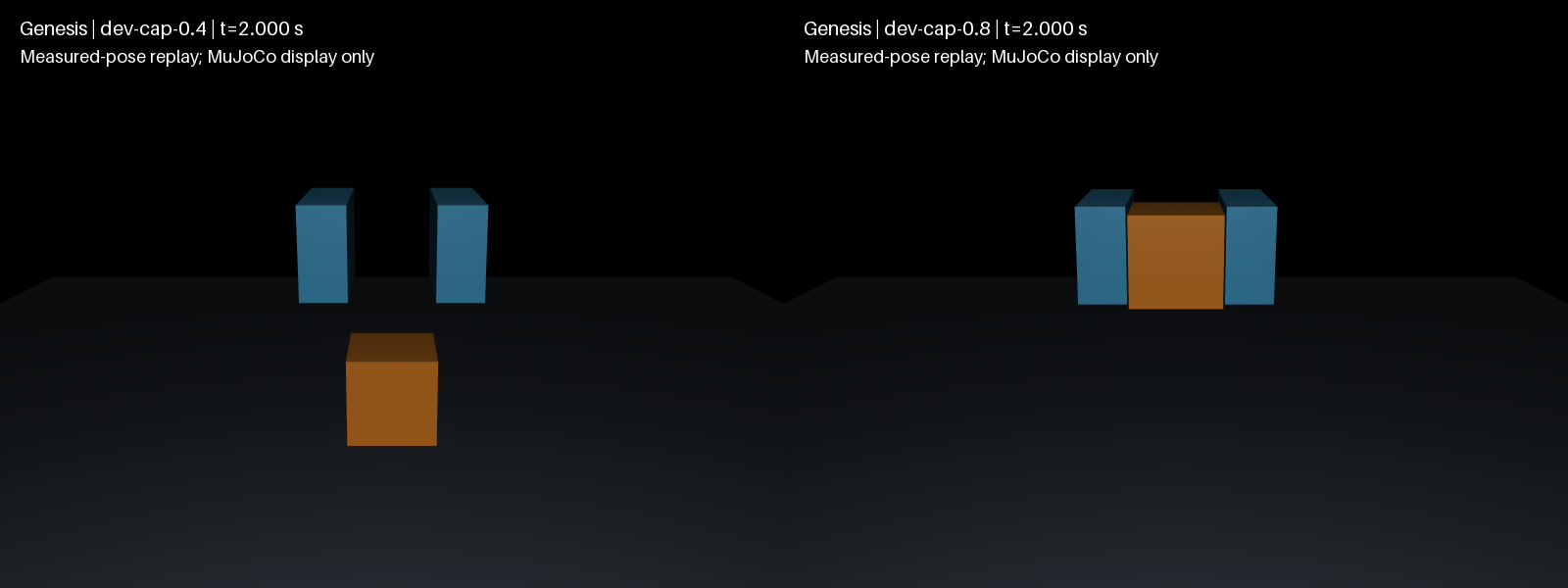
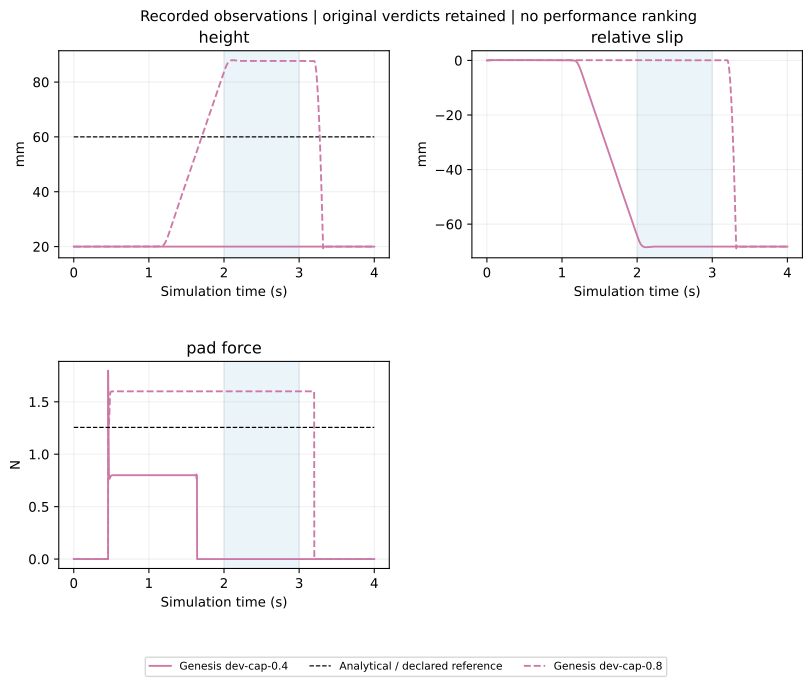
Synchronized replay, full-rate curves, parameters and original evidence
LIBERO: native task, timestep control and observation fix#
Same actions, initial state, Panda and native success; original 2 ms versus unqualified 1 ms control. Heldout task success stays 10/10, screens change from 5/10 to 3/10, and cost doubles. Policy effects of observation refresh remain unverified.
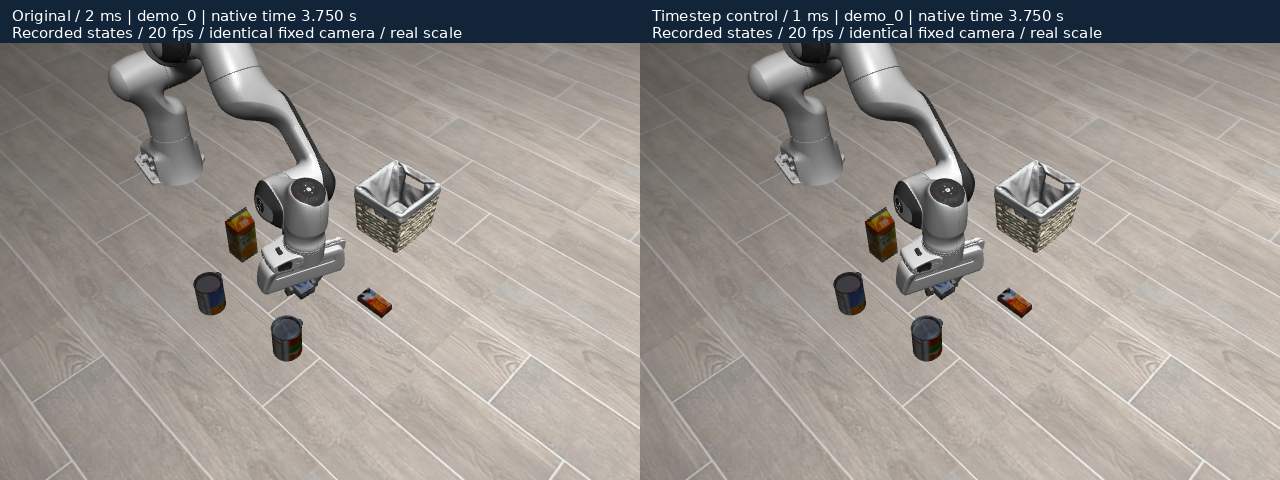
Synchronized replay, full-rate curves, parameters and original evidence
Which engines and solvers are compared?#
Engine |
Roles in registered profiles (not peer algorithms) |
Experiment versions and paths |
|---|---|---|
MuJoCo |
Constraint method: CG (nonlinear) · Newton · PGS |
3.11.0, 3.14.0, 3.15.0; native / historical paths in matrix |
SuperDex |
Deformable implementation: experimental-shell |
1.0.0; native / historical paths in matrix |
Genesis |
Deformable implementation: PBD |
1.4.3; native / historical paths in matrix |
Newton Physics |
Implementation/system: Featherstone · Kamino · SemiImplicit · VBD · VBD compliant · VBD legacy · XPBD |
1.6.1 / Warp 1.18.0, 1.7.0.dev0 @ 2dee3234; native / historical paths in matrix |
PhysX |
Deformable implementation: surface cloth |
5.9.0; native / historical paths in matrix |
Drake |
Constraint method: SAP |
1.57.0; native / historical paths in matrix |
Native and framework MJWarp are separate paths with their actual core identified. Newton Physics is an engine project; Newton is also an algorithm name. Tested SuperDex BFGS/SR1 with assembly period=1 execute Newton-equivalent steps; configuration names are not independent algorithm counts.
This is a research inventory including failures and unqualified entries. Execution, CPU/GPU, precision, full profiles and unsupported reasons: 完整矩阵 / Full matrix。
Roles interpret recorded names within each engine, not identical mathematical problems or evidence that every combination ran. AUTO is a selection policy; missing identities are not filled from defaults.
Comparison boundary: distinguish system-profile selection from controlled algorithm attribution. Read record integrity, numerical consistency, physical references and task outcomes separately; original scores and failure denominators are unchanged. Roles and evidence guide。
Thin-feature SDF geometry/response qualification remains #178; cloth material, collision/coupling and grasp baselines remain #179. Existing development passes are not calibrated cross-engine material comparisons.
MJWarp path comparison (MuJoCo core)
Runtime path |
Actual physics core |
Solver / contact path |
Task acceptance |
|---|---|---|---|
Isaac Sim6.1.0 local tag build / Newton1.5.0 / vendor Warp1.16.0 |
MuJoCo 3.11.0 |
MJWarp Newton / pyramidal / Newton contacts |
|
Isaac Sim6.1.0 local tag build / Newton1.5.0 / vendor Warp1.16.0 |
MuJoCo 3.11.0 |
MJWarp Newton / pyramidal / MJWarp contacts |
|
Native matched core / vendor Warp1.16.0; original and four-field aligned |
MuJoCo 3.11.0 |
MJWarp Newton / pyramidal / MJWarp contacts |
Model/clock diagnostics already exist; task acceptance retains the matrix state. Path differences #152 remain a separate research question.