Render recorded experiments#
Studio replays make contact, material surfaces and object motion easier to see. They reuse saved states: rendering never advances a physics engine, changes a task score or repairs a failed grasp.
The homepage gathers the experiments in one preview table. Cut-push uses repaired linked-volume surfaces with RTX path tracing, and cloth uses the recorded mesh studio views. Rigid scenes use the official MuJoCo USD exporter and OVRTX path tracing. RSS uses its separately pinned upstream RTX replay. These are different presentation paths with explicit source records, not a claim of one unified physical model.
Actual replay gallery#
These 13 complete replays retain the source times and scale. Apple uses two independently verified 14 s regression records; the other scenes retain the published historical records. The six incline panels use the same body-follow camera, with world position printed below to retain the motion reference.
| Experiment | Replay | Video |
|---|---|---|
| Apple grasp: MuJoCo / SuperDex | 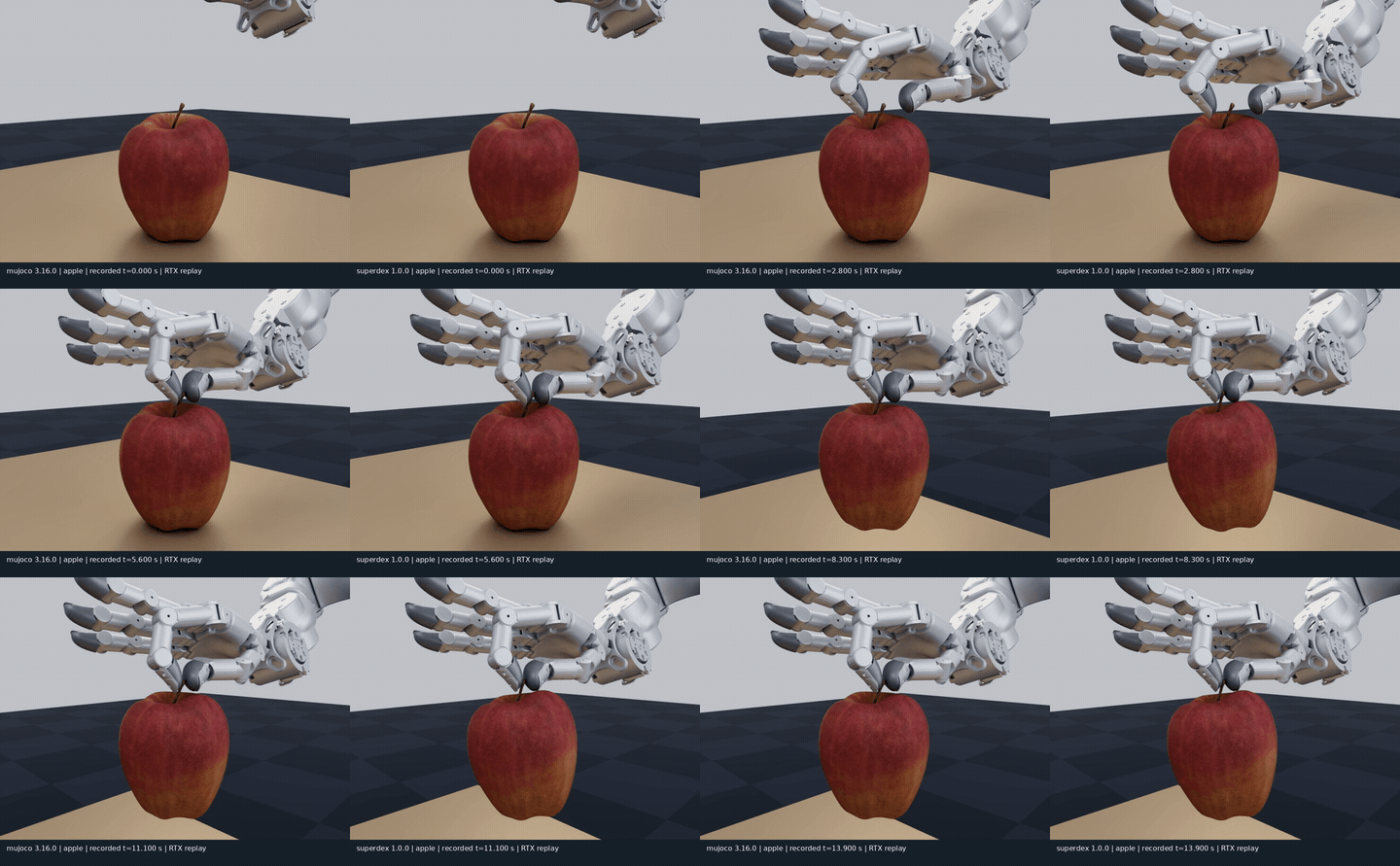 | MP4 |
| Genesis: 0.4 N / 0.8 N limits | 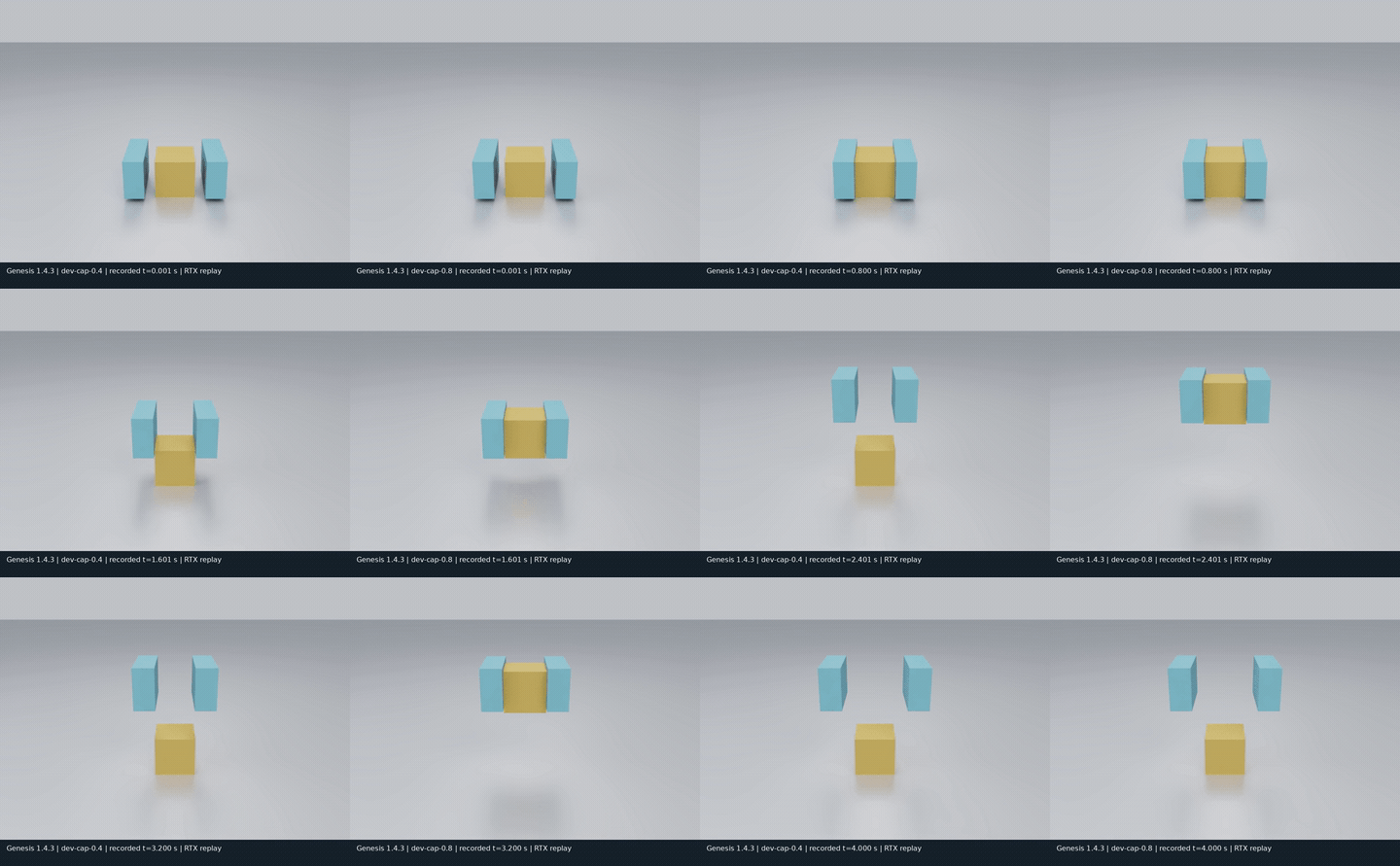 | MP4 |
| LIBERO demo 0 | 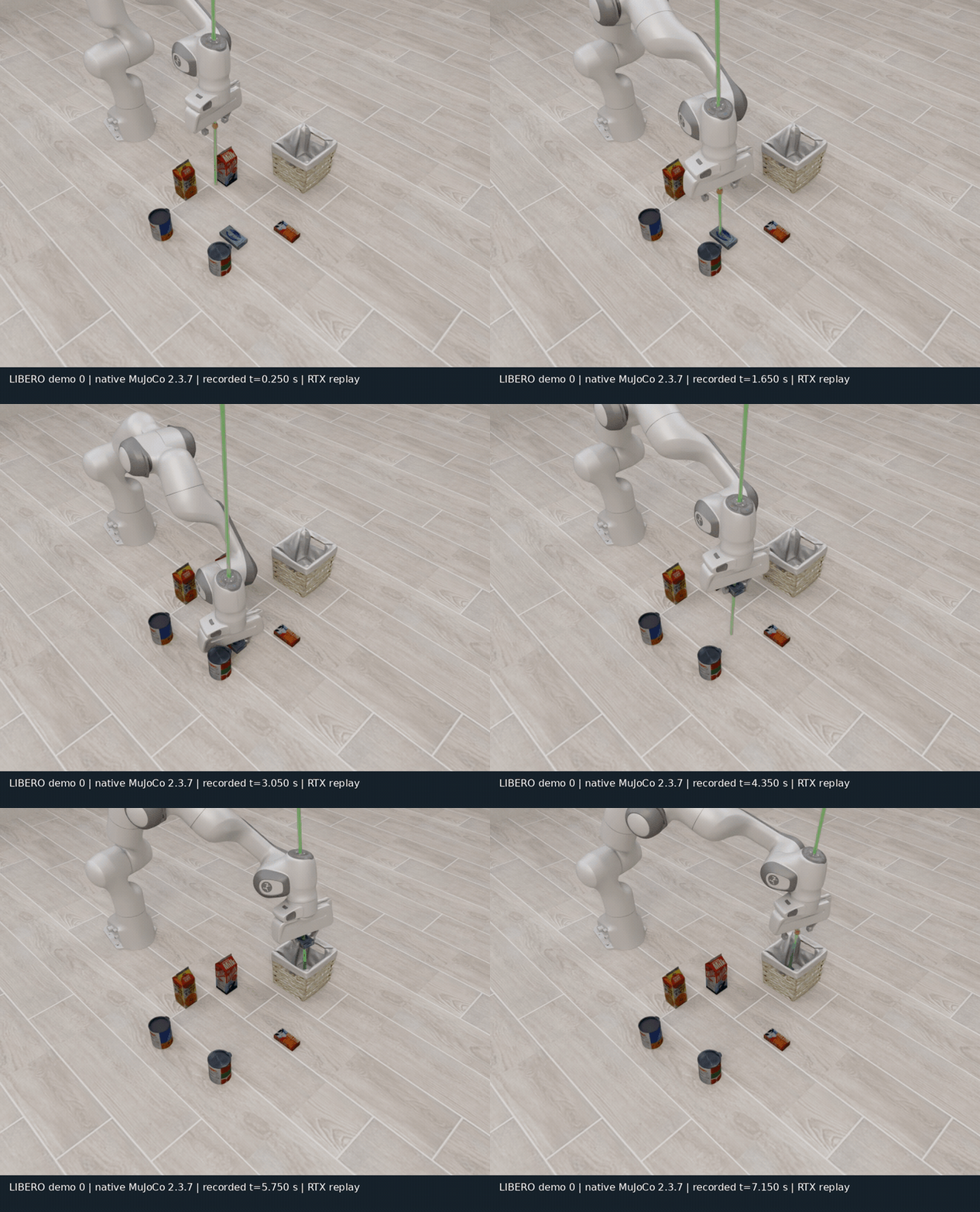 | MP4 |
| Six-engine incline | 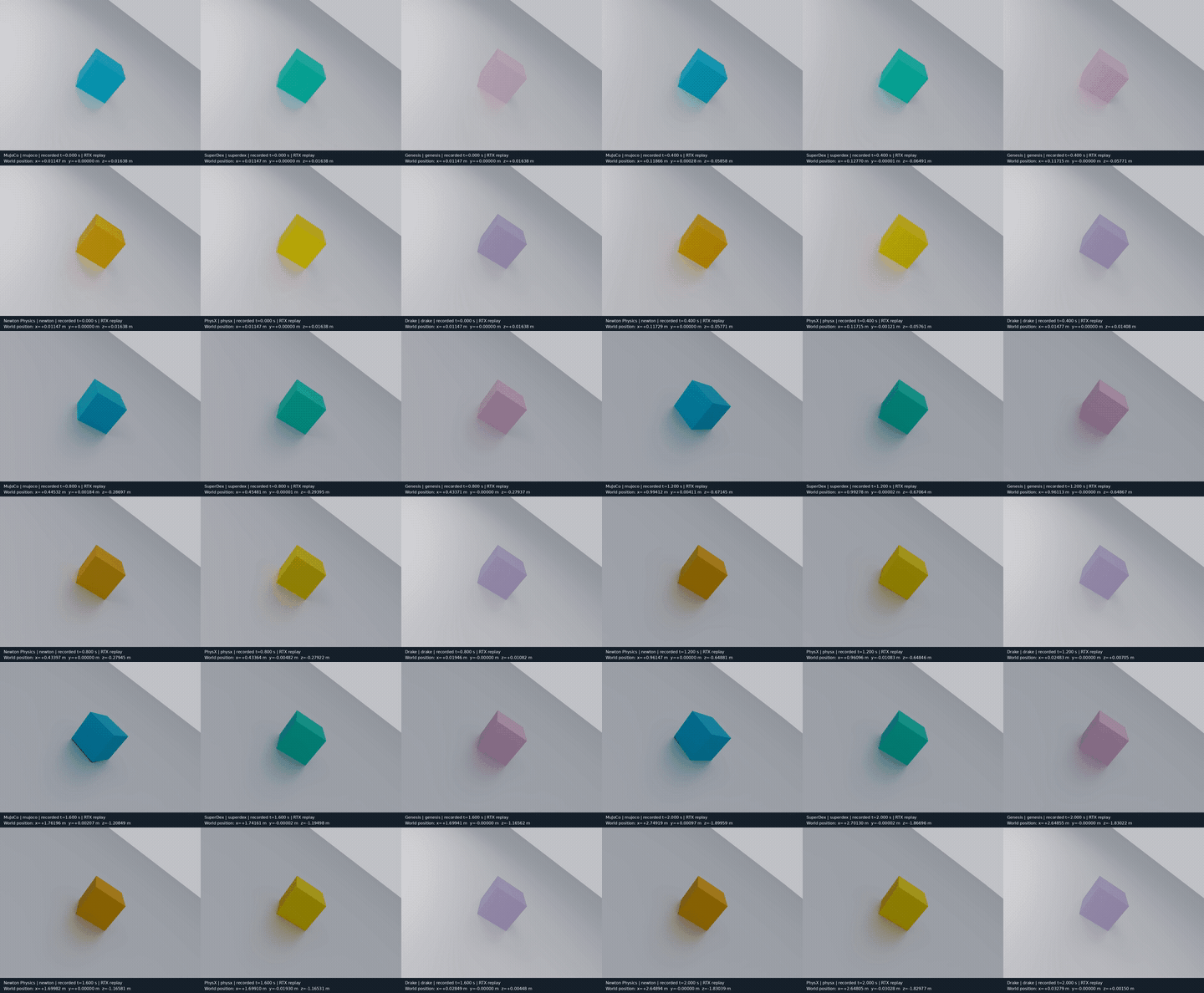 | MP4 |
| Initial / calibrated normal response | 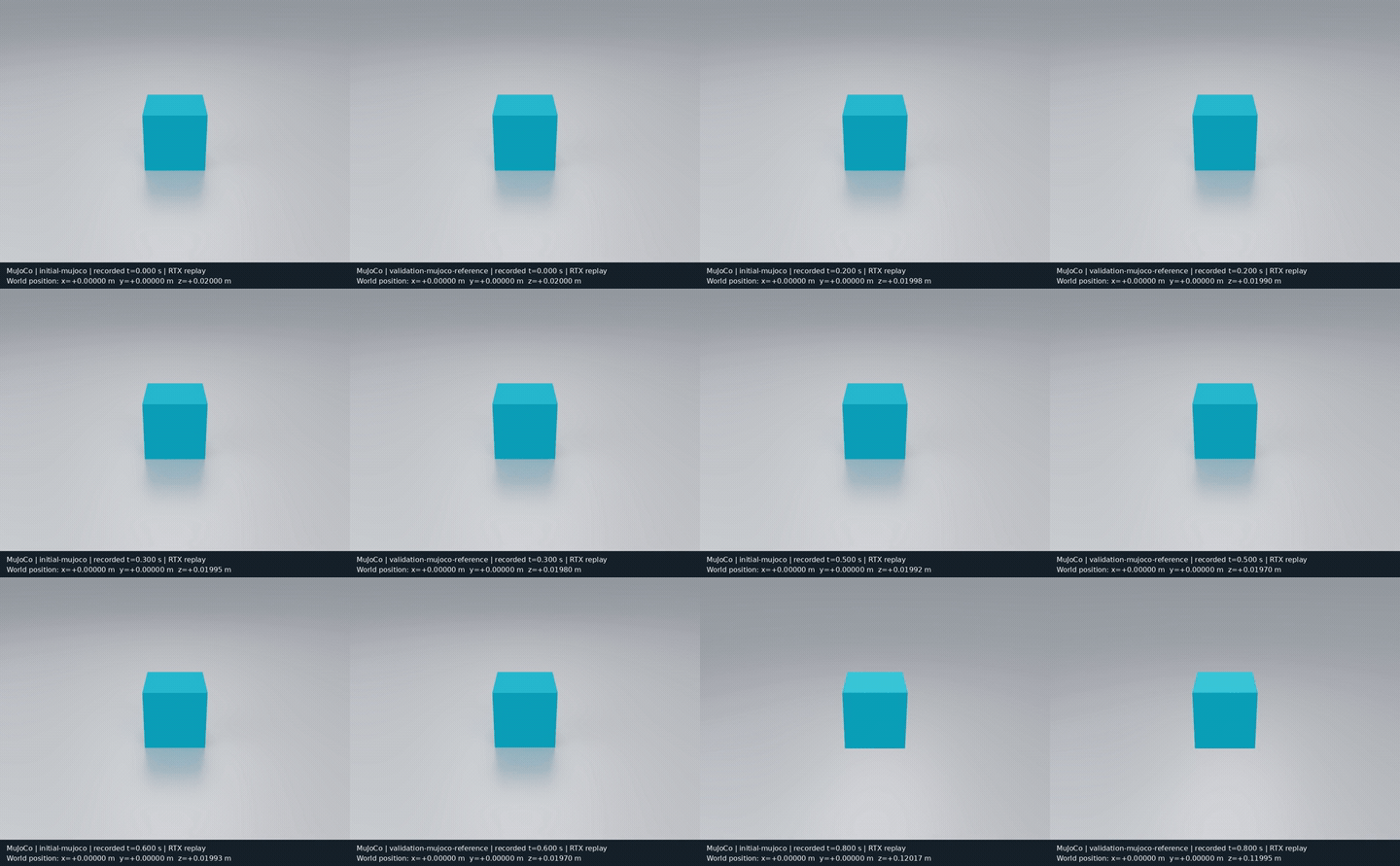 | MP4 |
Cutting surface reconstruction and cloth studio comparisons retain their separate geometry and provenance. RSS matched tiled/RTX views remain available. The RSS homepage GIF and these appearance comparisons use the original recording with compliant latch assistance. Changing the renderer does not remove that constraint; see the latch explanation and no-latch comparison for contact-only outcomes.
Replay a rigid scene#
Use the optional render environment with Python 3.12, MuJoCo 3.12.0, OpenUSD, NumPy, Pillow, imageio/FFmpeg and OVRTX 0.4.0.346409, plus an RTX-capable NVIDIA GPU/driver. These are display dependencies; each source record retains its original physics engine version. The first render includes shader and renderer startup costs.
PYTHONPATH=src python scripts/prepare_studio_replays.py apple PATH_TO_VERIFIED_RUN OUTPUT
PYTHONPATH=src python scripts/prepare_studio_replays.py pinch dev-cap-0.4 OUTPUT
PYTHONPATH=src python scripts/prepare_studio_replays.py incline INPUT_MAP_JSON OUTPUT
PYTHONPATH=src python scripts/prepare_studio_replays.py normal INPUT_MAP_JSON OUTPUT
The apple run contains trajectory.npz, display.xml, engine identity, a passing independent summary and its referenced assets. The input map resolves the immutable release records listed in the existing visual-comparison source manifest. Existing loaders check record hashes and published scores. Outputs must be new directories; add --pilot for beginning/middle/end frames.
LIBERO keeps an additional compatibility check. In its original MuJoCo 2.3.7 environment, freeze every recorded frame’s native geometry:
python scripts/studio_libero_reference.py RAW_DIRECTORY REFERENCE.npz
Then, in the RTX environment:
PYTHONPATH=src python scripts/prepare_studio_replays.py libero RAW_DIRECTORY OUTPUT \
  --reference REFERENCE.npz
The adapter checks every mesh vertex in world coordinates at every source frame against the original runtime, with a 10 µm maximum tolerance. A mismatch stops rendering. The original robosuite collision group remains hidden as in the historical display.
What changes in the picture#
Three large area lights and ambient illumination replace the display lights. Geometry, textures and dimensions come from the saved scene; cameras follow the existing close-up or body-follow conventions. Frames select existing timestamps without interpolating motion. Shader materials describe appearance, not measured friction or compliance.
Each output includes replay.mp4, three stills, a USD stage and provenance.json: input and output hashes, frame indices/native timestamps, camera transforms, renderer settings, measured wall time and runtime transform readback. All exported object and camera matrices are checked at every rendered frame. Float normalization of quaternions is limited to 1e-14 during kinematics; original state arrays and source files remain unchanged. Path-tracing history resets for every frame and motion blur is disabled.
The reconstruction, lighting, denoising and 20 fps sampling are presentation choices. Fine penetration, force timing and task validity must be read from the original full-rate records and reports. Render time is not physics throughput or a real-time benchmark.